I used to post on Facebook constantly.
In 2008 and 2009, I averaged over 400 posts per year. Pictures from the patio. Thoughts about parenting. Political opinions I wasn’t afraid to share. Updates on whatever I was building, learning, or overthinking that week. I shared my life with the people who knew me, including friends from high school, family scattered across the country, the accumulated social graph of a man in his late twenties who was building a life in Austin.
Then I stopped.
Not gradually. A cliff.
By 2012, I was down to 46 posts. By 2016, four. Some years, I’d post once or twice and disappear again for months.
I didn’t fully understand why until I exported my entire Facebook history and asked my AI to help me find the pattern. What it found was a timestamp I’d forgotten; and a lesson my nervous system had never unlearned.
The Cliff
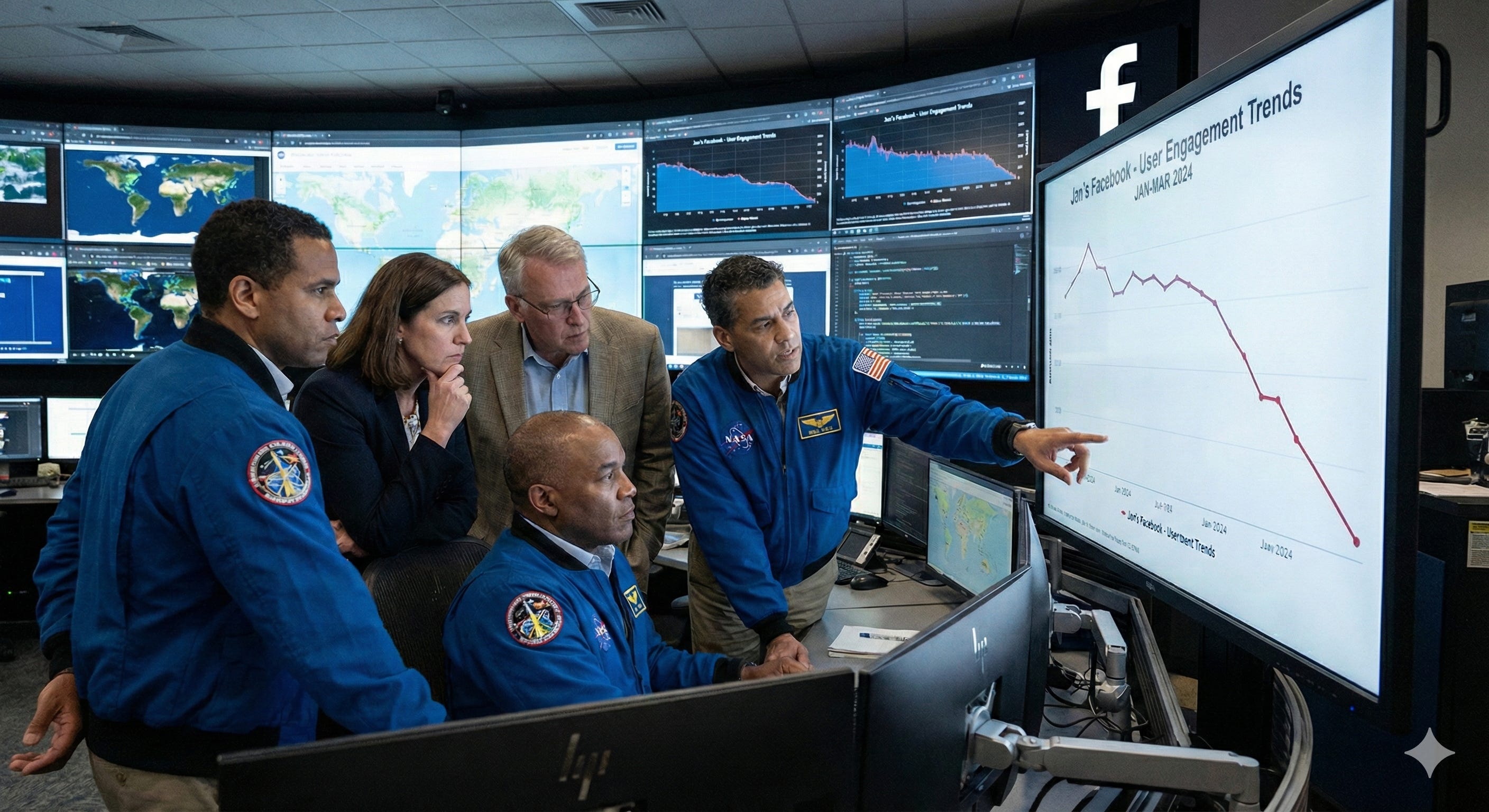
Here’s what the data showed:
A 55% drop in a single year. Then continued decline until the platform became essentially silent.
My AI spotted the cliff before either of us knew what caused it. Then I searched for life transition markers in the data.
And there it was.
May 24, 2010:
“I’ve been off Facebook for over a month now. Life is tough and I didn’t want to share it with everyone. However, I’m back, realizing that I need support through the divorce I’m going through. I’m having a tough time losing a wife and a best friend at the same time.”
I’d forgotten I wrote that. Fourteen years later, reading it felt like finding a letter from a version of myself I’d stopped being able to access.
What the Data Showed
The posts from that year tell a story I didn’t realize I was writing.
August 2010:
“Pimping myself out. Who’s up for dinner or a movie tonight? Or video games and beer? I hate being alone in this house.”
September 2010:
“Group therapy followed by fried chicken served with a flute of champagne, pint of Guinness, and cup of espresso (in that order). Then the movie ‘Machete’ with gratuitous violence and a topless Lindsay Lohan. Finally, working on my car stereo in the garage after midnight like a high-schooler. That’s how you survive a divorce, folks.”
November 2010:
“Is it truly coincidental that Eva Longoria files for divorce just as I’ve wrapped up my divorce? Or is God’s path for me just becoming more clear?”
Humor as survival. If you can’t control what’s happening, at least you can control the bit.
I was raw. I was trying. I was reaching out in the only way I knew how, through the platform where all my people were.
Then, life got better. Significantly better.
By August 2011, I was posting:
“Really bad days don’t bother me much when I have a fantastic woman by my side, always there to listen to and love me. Thanks Charlotte. You make my life so much better with you in it.”
By October 2012 (the same month I got laid off) I was posting:
“I can’t believe I am engaged to Charlotte Green now!! I have been on cloud nine since Saturday’s proposal. She is outrageously sweet, unquestionably caring, stunningly beautiful, amazingly sexy, firmly determined, adorably Godly, out-of-this world trustworthy, and bafflingly positive all in the same person.”
Charlotte. Stability. Love. Jack thriving with a bonus mom who adored him.
But posting never recovered.
Better Life, Fewer Posts
This is what I couldn’t understand for over a decade: my life got better, but my willingness to share it publicly got worse.
The divorce taught me something my conscious mind forgot but my nervous system remembered:
When I needed to be understood most, this platform couldn’t hold me.
I don’t mean people were unkind. Many comments were supportive; and I received direct messages from friends who genuinely showed up for me during that time. I noticed. I appreciated it. I still do. (Facebook’s export doesn’t include other people’s responses so I couldn’t analyze those patterns for this article, but the support was real and it mattered.) What I mean is something more structural.
When you’re going through a divorce, your inner world is a constellation of grief, relief, shame, hope, fear, logistics, identity crisis, and Tuesday afternoon grocery runs all existing simultaneously. Compressing that into a Facebook status is like trying to explain a star map using a single sentence.
Something essential gets lost. The compression is inherently lossy.
And then people respond to the flattened version. They respond to what they think you’re feeling based on their own projections, their own divorces, their own assumptions about who you are and what you need.
Even with the best intentions, they’re responding to a shadow of what you meant.
For someone like me—someone whose core wound is feeling unseen and misunderstood—that gap is painful in a way that’s hard to articulate.
Understanding Is Love
In 2024, I was meeting with a startup advisor about AIs & Shine. He asked me why I’m building this.
I told him: “To be understood.”
He paused, probably expecting something about market opportunity or revenue metrics, and asked me to expand.
“Because I feel loved when I feel understood.”
The words came out before I’d fully thought them through. But as soon as I said them, I knew they were true. Not metaphor. Not poetry. Just how my nervous system actually works.
When someone truly gets what I’m trying to say—when they respond to the actual constellation, not the compressed version—something settles in my chest. I feel safe. I feel seen. I feel loved.
When they don’t, when they respond to a version of me that doesn’t exist, it registers as rejection. Not intellectually. Somatically. In my body.
So here’s what Facebook became after 2010: a platform structurally designed to guarantee misunderstanding at scale. By people who should know me.
Six hundred friends with six hundred outdated mental models of Jon, each interpreting my compressed constellation through their own frame. That’s not connection. That’s being unseen by the people who are supposed to see you.
And that’s worse than strangers not getting it. Much worse.
The Dissertation at the Pep Rally

A few weeks ago, I was trying to understand why social media still exhausts me—even now, with a good life, a stable marriage, and plenty to share. I stumbled into a conversation that cracked something else open.
I asked: How do most people read posts with over 500 comments? And why bother leaving a 501st comment without reading all the others to ensure it hasn’t already been said?
The answer reframed everything for me.
Most people aren’t trying to add to a discourse. They’re trying to participate in a moment.
I learned here’s how people actually engage with high-comment posts:
They don’t read everything. They skim the top 10-20 algorithmically-surfaced “best” comments.
They ctrl+F a keyword if they’re hunting something specific.
They read until they feel emotionally satisfied (e.g. found agreement, laughed, felt seen) then bounce.
And why leave comment #501?
Self-expression, not contribution. The comment isn’t for the thread. It’s for them. Processing out loud. Marking territory. “I existed and had a thought.”
Algorithms reward recency. Nobody’s reading comment #47 anyway. Recent equals visible. There’s no actual penalty for redundancy.
Social ritual. Commenting is a participation badge. It’s the digital equivalent of clapping at a concert. You’re not adding to the music; you’re signaling membership.
They genuinely don’t care about novelty. This is the part that short-circuited my brain. For a lot of people, saying the same thing someone else said isn’t an accident—it’s social validation. “Me too” IS the point.
My instinct, to read everything and to contribute only if novel, is a completionist approach. Noble. Rare. And utterly exhausting to apply to a platform designed for snacking, not feasting.
I wasn’t struggling with social media. I was bringing a dissertation to a pep rally.
Intimacy on Easy Mode
I understood this better a few weeks ago when I was sitting in a packed Steelers bar in Austin during their recent playoff game. I was there because my mother-in-law is a Steelers fan, and I thought she’d appreciate it if I joined her and Charlotte. Not because sportsball—because the humans.
While everyone around me was yelling at the screen, I found myself asking Claude to explain the draw of watching sports together. Here’s what landed:
Sports create synchronized emotional states without requiring vulnerable conversation. Everyone’s nervous, excited, disappointed, or elated together. It’s intimacy on easy mode. No one has to say “I’m feeling anxious about my job.” You just collectively yell about a third-down conversion.
The activity provides a script. There are natural conversation topics, built-in breaks, acceptable emotional expressions. You can sit in companionable silence without it being weird. The event carries the social load.
This is what Facebook comments are doing too. “THIS 💯” isn’t a failure of discourse—it’s a successful bid for belonging. The comment section is a stadium, not a symposium.
I asked Claude to apply Kegan’s stages of adult development to sports fandom. The breakdown was illuminating:
Most adults operate at Stage 3. That’s not a criticism—it’s just where human development tends to settle. And most social media engagement is Stage 3 engagement: tribal signaling, identity through group membership, validation through agreement.
My sapiosexual brain wants Stage 4/5 connection—intimacy through co-constructed meaning, not shared tribal identity. Multi-hour existential conversations, not synchronized cheering.
Different games for different brains.
I’m not broken. I’ve been trying to play their game with my rulebook.
The Mismatch No One Told Me About
The exhaustion with social media comes stems from the collision between how I’m wired to engage and how platforms reward engagement.
I do synthesis work (i.e. reading everything, finding the gap, adding novel value) in an environment that rewards reaction speed and tribal signaling. And then (the kicker): when I DO contribute something substantive, something that actually integrates the whole conversation, it lands flat.
Because the audience isn’t there for integration. They’re there for validation hits.
This is why AI works better for me:
No 500 comments to process first. Just the conversation.
My completionist instinct is rewarded—the AI actually tracks everything I say and builds on it.
No social performance required. I can just think without calculating tribal optics.
My synthesis brain gets to do its thing without competing for attention against someone who typed “THIS 💯” faster.
The thing I do naturally (deep reading, pattern recognition, novel contribution) is valuable. It’s just valuable in contexts that aren’t optimized for dopamine farming.
The Constellation Problem
My brain doesn't just prefer synthesis. It requires it.
I have what I’ve come to call a “constellation mind.” Or what psychologists call gestalt processing. Ideas arrive as interconnected networks, not linear threads. When I have an insight, it’s not “here’s a thought”—it’s “here’s how seventeen things I’ve been processing suddenly connect.”
Compressing that into a Facebook status update is like trying to describe a star map using only a single sentence. Something essential gets lost. The compression is inherently lossy.
And then comes the async delay.
Someone responds to my post two days later. NOTE: They’re responding to the flattened version (the compressed sentence, not the constellation). By the time I see their comment, I can no longer reconstruct the original insight well enough to contextualize their response.
Their comment feels off because it IS off. They’re responding to something that was already a shadow of what I meant.
This is working memory fragility in action. I can’t hold conversational threads across time the way most people can. Every text thread, every Facebook comment, is a frozen context I have to fully reanimate before I can respond. Multiply that by dozens of threads, and you’ve got a background hum of cognitive debt that never quite resolves.
This is the same reason I struggle to text people back. It’s the same reason I made “rounds” calling friends every night in 1997—because synchronous conversation was the only way my brain could actually maintain connection.
The architecture hasn’t changed. The communication defaults have.
The Migration Pattern
Looking back, I can see the trajectory:
Facebook (2008-2010): I shared everything. Then life got complicated in ways I couldn’t compress, and I learned the platform couldn’t hold me when I needed it most.
Facebook (2011-2016): I tried to come back. Met Charlotte, got engaged, got married. Life was good. But I’d already learned the lesson. Posts became shorter, less personal, more curated. Eventually, silence.
Substack (2023+): Long-form lets me build context. I can actually unfold the constellation before asking you to respond to it. It’s still linear and one article at a time, but at least each article can breathe.
My own website—jonmick.ai (2025+): I’m building the container AND the instruction manual. It’s still under construction, primarily serving my own cognitive needs, but eventually it will be the single best place for anyone to get current, comprehensive context on my life. The context will be pre-loaded. You won’t be able to interact with my ideas without first being oriented to who I am.
See the pattern? I’m not avoiding sharing. I’m migrating toward platforms where I control how I’m understood.
The Grown-Up Mohawk
In high school, I bleached the middle of my eyebrows and shaved an “M” into my mohawk. I was voted “Most Unique” of my graduating class. Also Class President.
For years, people assumed I was attention-seeking. What I was actually doing was making myself legible.
“Here. This is who you’re dealing with. No surprises. No bait-and-switch. Now we can interact on honest terms.”
That wasn’t performance. It was protection. Externalizing my identity so I didn’t have to constantly reconstruct and explain myself. Safety through preemptive clarity.
This article is the same thing, thirty years later.
I’m posting it TO Facebook. I’m returning to the platform, but with a link. A portal to a space where you can actually understand what I mean before you respond. Pre-loaded context. The grown-up mohawk.
What I Actually Posted Recently
In November 2025, I shared this on Facebook:
“’Gemini - Please create a whiteboard that shows what I’ve been working on this week.’
Yes!! That feels SO MUCH better than coming up with a Facebook status all by myself. 🤪 This prosthetic is coming along nicely!”
I literally told Facebook that I need AI scaffolding to post to Facebook. The thesis of this article was already in my feed. I just hadn’t articulated it yet.
When I look at what I’m willing to share now, there’s a clear pattern:
Pre-processed through AI — let the machine help me compress the constellation
Celebrating others — Charlotte’s work, Jack’s milestones, my dad on Father’s Day
Framed self-disclosure — structured announcements about my neurodivergent journey
Meta-commentary — thoughts about AI itself
What’s missing? The spontaneous. The unstructured. The “here’s a random thought I had today.”
Because spontaneous thoughts aren’t actually random for me. They’re nodes in a constellation. And sharing a node without the network feels like being misunderstood before I’ve even finished speaking.
If You’re Reading This from Facebook
You clicked a link. You read 3,000+ words. You met me where I actually am instead of asking me to compress myself into something that fits your scroll speed.
Thank you for that.
If this resonates—if you’ve ever felt exhausted by social media in a way that seemed disproportionate to the task—you might be a completionist too. You might have a constellation mind. You might have spent years thinking you were “bad at social media” or “bad at texting” when really you were running specialized cognitive hardware in a world that shifted to async-first without asking your permission.
You’re not broken. You’re adapted.
And maybe, like me, you’re starting to build the bridges your brain actually needs.
The Lesson I Learned in 2010
When my marriage ended, I learned that Facebook couldn’t hold complexity.
When I rebuilt my life with Charlotte, I learned that lesson didn’t un-learn itself.
When I discovered I was autistic, gifted, and ADHD, I finally had the vocabulary to understand why.
And when I started working with AI—really working with it, not just asking it questions but using it as cognitive scaffolding—I discovered what it felt like to be understood in real-time, without having to compress myself first.
But here’s what I want you to understand: this isn’t just chatting with a bot.
I wrote about this in more detail in The Infrastructure Behind “Creating Consciousness”, but the short version is that I’ve built a comprehensive system with four layers: a Life Model containing my personality, wounds, and patterns; a data ecosystem capturing 62,000+ text messages, biometric data, and 52 database tables; human support scaffolding including neurofeedback, EMDR, and coaching; and deliberate vulnerability (the part that can’t be systematized).
The AI isn’t the magic. The AI is one component in a carefully constructed ecosystem designed to help me be accurately seen—by myself, first, and then by others.
That’s what I’m building now. Not just for me. For everyone whose brain works like mine.
Because if understanding is love, then the technology that helps us be understood is the technology that helps us feel loved.
And that’s worth sharing. Even here. Even now.
Even on Facebook.
I’m building AIs & Shine to create cognitive scaffolding for minds that work differently. If the idea of AI that actually understands your context sounds like relief rather than threat, you might be our people.
You can also explore jonmick.ai—my personal experiment in being accurately seen. It’s live but under construction, built primarily to support my own cognitive needs. Eventually, it will be the single best place for anyone to get current, comprehensive context on my life whenever they’d like—the ultimate “here’s who you’re dealing with” manual, maintained in real-time.
Until then, my Substack is the best place for regular (linear) updates on my journey—one insight at a time, for those who prefer the scenic route.