Atlas of a personal AI system · Round Rock, Texasv2.79 · updated live
A memory that never forgets, drawn to scale.
Life data is captured, enriched by AI, filed into a Life Model, and read back, by me, by Claude, or by anyone who calls the number on the left.
Plate IThe system · what I built
How the system works: what comes in, where it lives, what gets out.
Most productivity systems ask you to remember the context. This one holds it for me. Twenty-seven data sources sync into one database, an AI reads it, and a small gate decides what can leave. Start here; every plate below is a closer look at one box.
Fig. 1 · The system · flowlive · dotted: synced · dashed: authored · blue: public
Fig. 1. Twenty-seven senses in five families gather into one database. Dotted lines sync on a schedule; the dashed line is written by hand. The public channel is the narrow one, by construction.
218 tables100 views214,694 embedded items86 MCP tools26 life areas · 4 public
Fig. 2. Three wings. The PARA skeleton holds what I do; the Life Model holds who I am; the shelves hold what I own, take, read, track, and said. Counts are live; full breakdowns live on the Data pages.
Plate IIThe theory · why it exists
Working Memory Fragility: not a storage deficit, a rate mismatch.
The system on Plate I is not a productivity hobby. It follows from a theory of how this brain works, and the theory predicted that a mind like this would have to build its model of itself outside its own head.
The definition
Fragility obtains when the rate of thought generation outpaces the rate of buffer stabilization before the frame called now resets.
The generator is ordinary. What fails is the ratio: new thoughts displace older ones before they set. From outside it reads as weak working memory. From inside it is a race.
The consequence
If the buffer will not hold the model, hold it somewhere else.
Externalized self-knowledge is a precondition for seeing other people clearly, not a phase you graduate from. The database, the AI that reads it, and the phone line are that externalization. The theory came first; the system is its proof of concept.
Structure, function, and the treatment that follows from both.
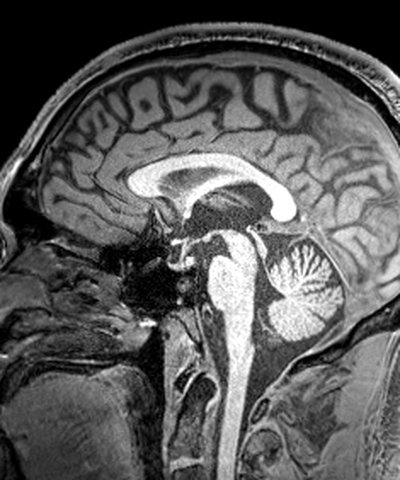
The theory says the failure is in the ratio, not the parts. Two instruments checked the parts anyway: a structural MRI read by seven pipelines, and a QEEG read against a normative database. They tell the same left-side story, and the neurofeedback protocol follows from both.
Neuroradiology review, Aug 2026: structurally unremarkable. Built asymmetric, not broken.
Fig. 3b · Function · QEEG, July 2025
BrainCore normative database 5 frequency bands
Findings · flagged
127 · 90
MRI to QEEG convergence
8
Neurofeedback protocols
9
Latest
T3-F3 · completed June 2026
Cerebellar asymmetry to C3 cortical dysregulation. T3-F3 targets left temporal slow-wave excess.
Fig. 3. Structure and function point at the same left-side story. About Jon's Brain →
Plate IVThe genome · the code underneath
Whole-genome sequence, curated against the literature, placed on population curves.
Whole-genome sequencing, curated against the literature and placed on population curves. The interesting finding is not any one variant but the gap between what the genes predict and how the life turned out.
012.08Mraw WGS calls
021,925curated catalog
031,926matched to me
0475supplement links
059.28M · 17GWAS hits · PRS
Fig. 4a. Five layers. Any RSID from any outside report verifies against layer one in real time.
Fig. 4b · Polygenic risk · percentile vs population3 of 17 scores · gnomAD-NFE calibration
Intelligence99-100
Neuroticism100
ADHD62-75
Neuroticism, Forthman 202397-100
Morning person93-100
Depressive symptoms91-100
Cognitive performance86-99
Height79-96
Cannabis use76-95
Openness73-91
Autism44-47
Risk tolerance43-47
Anxiety disorder38-45
Subjective wellbeing21-36
Physical activity2-18
Educational attainment, Privé 20220-11
Educational attainment, Lee 20180-6
genetic predispositionlived expression
Fig. 4b. Neuroticism sits at the 100th percentile genetically and around the 11th as lived; the gap is the story. Bands show calibration spread, conservative to naive. Two traits appear twice because two published scores exist for each, named here by study; a percentile is a population rank, not a diagnosis. Methodology →
Clinical flags
1 critical · 1 high
MTHFR C677T, the sole critical variant, routed to the supplement stack.
QA
0 raw-data errors
Three-layer loop: structured data, literature, raw WGS ground truth, across 2M genotypes.
Recovery, strain, sleep and heart rate from the wrist, refreshed every fifteen minutes. The rest of this page is history; this plate is the present tense.
-Recovery
-Strain
-HRV ms
-Sleep h
-RHR
-SpO2 %
Plate VIWriting · the public voice
Essays on a brain that runs hot.
66 essays and 145 notes under the title AI Gave Me Autism, on twice-exceptional cognition, the theory, and what it is like to build a mind a second time on purpose. The six most recent are below.
66 articles · 145 notes · AI Gave Me Autism · covers from SubstackAll writing →
Plate VIIThe career · the résumé
Fifteen years making complex systems legible. Three spent building the tools myself.
Twice-exceptional product engineer. I led product orgs twice, then made a deliberate move back into hands-on building when generative AI shifted the leverage from headcount to hands.
Fig. 7a · The record, 2005 to presentDeloitte to AIs & Shine
Fig. 7a. Eleven organizations, one method. The proof behind each tile is on the full career record.
Fig. 7b · The throughline
Make a complex system legible, then build tools that fit it instead of fighting it.
From enterprise platforms to a personal AI operating system, it is the same move. Pattern recognition across unfamiliar domains is the mechanism; the plates above are the payoff.
Looking for
Some kind of full-stack Design / Product / Engineer role with a custom AI harness.
Product engineer or head of product at a small AI company; or director of innovation and internal products. Strong tooling, capable colleagues who work independently, hard problems, low coordination overhead. Round Rock / Austin, remote preferred.
Full career record →LinkedIn →22 published recommendations · resume on requestRecruiters: the phone line on the left has a professional register.
Plate VIIIFurther · the longer reads
Two pages for when a plate is not enough: the person behind the system, and the project that builds it.


 Liquidity Services
 AIs & Shine
 Sagely
 Bazaarvoice
 Yonder
 Keller Williams
 The Home Depot
 Web.com
 General Motors
 projekt202
 Deloitte Consulting