Author's note: I first published a version of this in December 2024, when I had exactly one subscriber and was three months into my AuDHD discovery. I didn't have the vocabulary yet for what was actually happening. Fifteen months later, I do. This is the same article, rewritten with what I've since learned about working memory fragility, external scaffolding, and why 300 open tabs aren't chaos. They're architecture. If you're curious what the original sounded like, you can read it here.
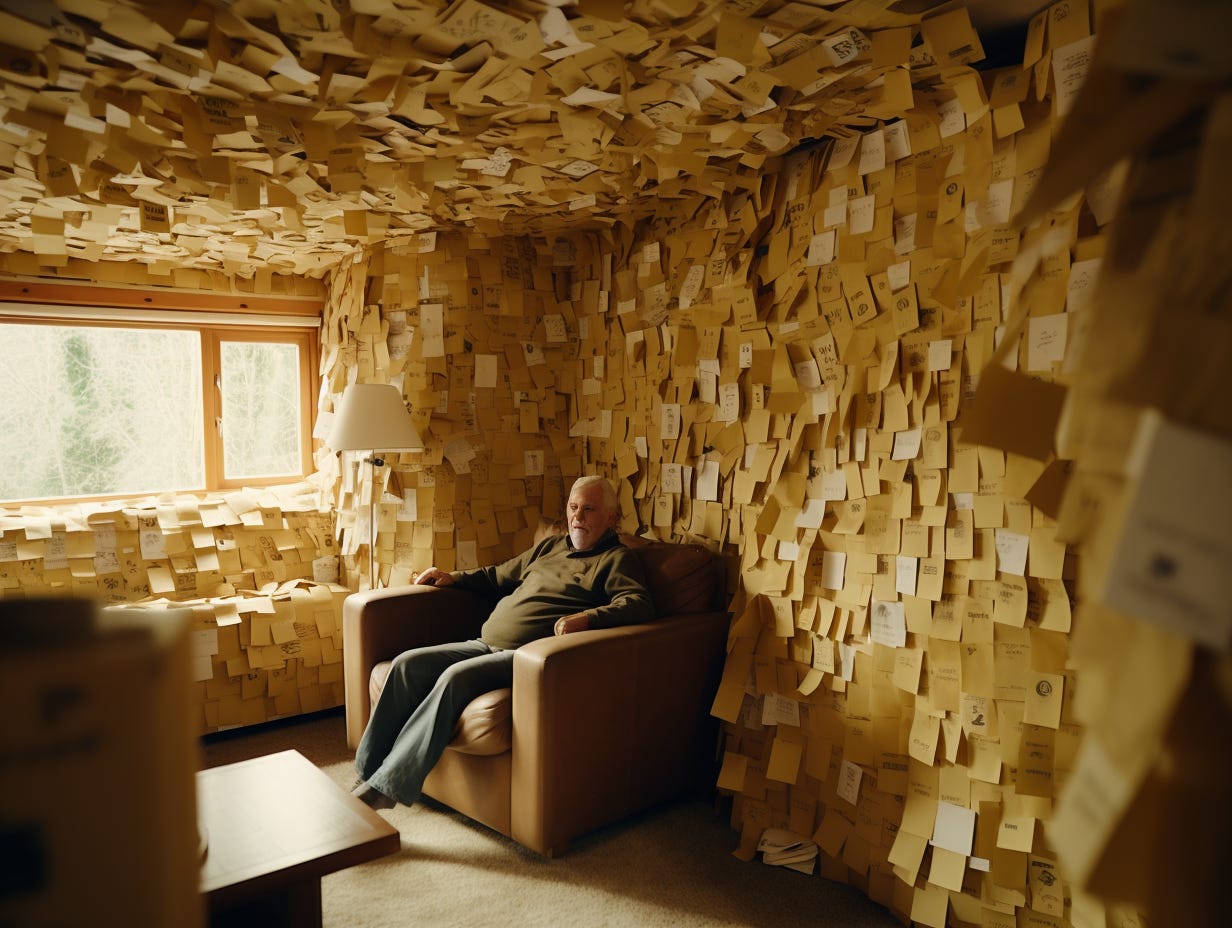
TL;DR: I have 300 browser tabs open right now. That’s not a confession of disorganization. It’s a map of how my brain actually works. Every open tab is context I don’t have to hold internally, every Notepad window is a thought I froze before it disappeared, and every email subscription is a question I haven’t finished asking. What looks like chaos is architecture. And once I understood that, I stopped trying to fix it and started building with it.
If someone were to crack open my laptop or phone and glimpse the sheer number of open tabs, notes, apps, and emails, they might think I’m drowning in a sea of digital clutter. And, honestly, they wouldn’t be entirely wrong. But what looks like chaos on the surface is a mirror to the way my neurocomplex mind operates: fast, fragmented, endlessly curious, and always hungry for connections.
Let me walk you through what it’s like to live with a “browser tab brain.”
Tabs on Tabs on Tabs
Let’s start with the most obvious example: the 300 tabs open on my laptop. Each one represents a thread of curiosity, a rabbit hole I dove into, or a problem I wanted to solve. They’re mental bookmarks for questions and ideas that feel too important to close, even if I know I may never revisit them.
Closing a tab isn’t deleting a page. It feels like shutting the door on a possibility. What if that tab holds the key to the insight I’ve been chasing? What if I’ll need it later and won’t remember how to find it?
That second question is the one that matters. Because for me, working memory is fragile. The thoughts are vivid and high-fidelity in the moment, but they don’t survive the frame reset. I don’t leave 300 tabs open because I’m disorganized. I leave them open because my brain encodes information at high resolution and then lets it go. The tab is the scaffolding. Without it, the thought doesn’t exist anymore.
My brain often says “yes” to more questions than it has time to answer. Each tab reflects an intention I couldn’t fully honor, a curiosity I couldn’t satisfy. In many ways, my open tabs are an external representation of my internal state: an overflowing inbox of ideas, half-finished projects, and unsolved mysteries.
The Overflow System
When my brain can’t contain the sheer volume of thoughts, it spills into the digital world. That’s why I have 40 Notepad windows open at any given time. These notes aren’t essays or neatly organized ideas. They’re fragments: snapshots of insight, reminders, and questions. They’re how I offload the mental overflow.
My thoughts rarely follow a linear path. They branch out in every direction, often interrupting themselves before I can close the loop. My notes are an attempt to freeze those fleeting ideas before they disappear. And while my notes provide some relief, they also create a secondary chaos: a fragmented system of half-thoughts that rarely get consolidated. They’re both a solution and a symptom.
I used to think this was a problem. I thought organized people consolidated their notes into neat systems, and I just... couldn’t. Now I understand it differently. My brain processes at high fidelity. The cost of that processing speed is that context doesn’t persist. The notes aren’t evidence of failure. They’re honest infrastructure for a consciousness that reconstructs itself constantly.
200 Emails a Day
I wake up every morning to a tidal wave of emails: newsletters, updates, offers, and messages from colleagues, friends, and strangers. These aren’t distractions; they’re the inputs I’ve invited into my life.
Every newsletter I sign up for, every mailing list I join, represents a piece of the puzzle I think I need. It's as if I'm saying, "Maybe this will help me understand myself better," or "Maybe this will spark my next big idea." The problem is that my brain struggles to filter these inputs. Instead of acting on the information, I often feel paralyzed by the sheer volume of options. Not because I can't decide, but because each option feels equally alive. When everything connects to everything, triage feels like amputation.
My Digital Battlefield

The sheer quantity of apps on my phone (each pinging with notifications, updates, and reminders) is another layer of this ecosystem. They reflect the tools I use to manage my chaos, but they also compete for my limited bandwidth.
Each app is like an employee in a company, each responsible for a specific function: organizing my notes, tracking my habits, communicating with others. But as my mental workload grows, even the most sophisticated tools start to feel like clutter. They offer solutions while simultaneously demanding attention. Allies and adversaries at the same time.
The Architecture Underneath
You see, the browser tab brain isn’t a disorder. It’s a cognitive architecture running a different operating system.
My brain processes information quickly, which means I’m constantly moving from one thought to the next. That speed is a genuine asset. But the cost is that sustained attention on a single task requires more energy than the task itself. It’s like a sports car with incredible acceleration but no cruise control. The engine is powerful. The idle is just... loud.
My intellectual and emotional intensity (what Dabrowski called overexcitabilities) amplifies everything: my curiosity, my need for closure, my awareness of possibilities I might miss. I can’t just dip a toe into a topic. I have to dive in headfirst. And once I’m in, my working memory is holding context at a resolution that’s genuinely expensive to maintain.
Then there’s the part I used to call “executive functioning challenges.” I struggle with prioritizing, organizing, and finishing tasks. But framing it as a challenge implies there’s a standard I’m failing to meet. What I actually have is a brain that’s brilliant at starting things, extraordinary at seeing connections between them, and genuinely costly to run on the kind of sustained, sequential work that neurotypical systems reward. It’s not a deficit. It’s a different set of engineering constraints.
And underneath all of it is a need for connection. Whether it’s browser tabs, emails, or apps, everything I engage with represents a link to an idea, a person, or a possibility. My brain thrives on these connections, even when they overwhelm me.
Building With It (Not Against It)
I spent years trying to fix the browser tab brain. Triaging tabs, consolidating notes, unsubscribing from newsletters, deleting apps. Basically applying neurotypical organizational frameworks to a brain that doesn’t run on that operating system.
Some of it helped around the edges. But the real shift happened when I stopped treating the chaos as the problem and started asking a different question: What infrastructure does my consciousness actually require?
The answer: external scaffolding. Not as a crutch. As honest architecture for a brain that processes at high fidelity but doesn’t persist context the way other brains do.
My 300 tabs aren’t clutter to be cleaned up. They’re context I don’t have to hold internally. My Notepad windows aren’t disorganization. They’re working memory I’ve externalized. My email subscriptions aren’t decision fatigue. They’re a curiosity engine feeding a brain that runs on novel connections.
The work isn’t “get organized.” The work is building systems that match the architecture. Ones that compensate for what’s genuinely fragile (working memory persistence, sequential prioritization) while preserving what’s genuinely powerful (high-fidelity processing, cross-domain pattern recognition, creative recombination).
That’s a fundamentally different project than buying a Bullet Journal or taking a class from David Allen.
The Beauty in the Mess

I wouldn’t trade my browser tab brain for anything. Yes, it can be exhausting to live in a world where my thoughts never stop, where ideas collide like atoms in a particle accelerator, and where the simplest task can feel like navigating a labyrinth. But this chaos is the engine of my creativity, the fuel for my relentless pursuit of meaning, and the reason I can engage deeply with ideas that others might skim over.
The tabs, the notes, the emails. They’re evidence of a mind that refuses to settle. They’re the fingerprints of someone who sees possibility everywhere, even when it’s overwhelming.
If you’re reading this and recognizing your own brain in the description, here’s what I want you to sit with: the world will keep handing you organizational systems designed for a different operating system. You’ll keep feeling like you’re failing at something everyone else figured out. But maybe you’re not failing. Maybe you’re running different hardware, and you’ve been trying to install the wrong software.
The question isn’t “how do I fix this?” It’s “what does my brain actually need to do what it’s built for?”
As I write this, I’m glancing at the tabs still open on my screen. There’s one about a research paper on neurodivergence, another about an AI tool I’ve been meaning to test, and yet another about decluttering techniques (yes, I see it). I could close them all, but I probably won’t. They’re extensions of my mind. Context I externalized before it disappeared.
And that’s not chaos. That’s architecture.
Human. Deeply seen.