Notes & Comments
Short-form thoughts, replies, and conversations on Substack.
Engagement stats are approximate and may not reflect current counts.
Yeah, so with that. I have some questions…
Do I like a comment to show that I read it and that it contributes to my thread? And then respond with a comment regardless? Or only respond if I have something to say in the moment? But what if that person wrote a long comment? Does mine need to be just as long?
And then if I know there's risk of me forgetting to leave a comment, do I hold back the like, and use that instead to keep track (in my Activity) of comments I still need to reply to; even if it means I might keep forgetting or never get to it, which would result in that comment getting neither a like nor a comment?
But then if I do leave a comment that took me 5 minutes to draft, should I instead restack their comment but with my response now as a note, for the benefit of my followers, without that person agreeing for their vulnerable note to be restacked?
Finally… is this what it feels like to be a neurodivergent female learning how to mask?
Good news: I can finish my work 10x faster
Bad news: I'm still procrastinating
Just noting this today. Next week, after I loop back around to it while in the shower, and then spend 6.5 hours in Claude Code with my brain's MRI/EEG results, I’ll solve it with AI.
That's my new life. 😵💫
Whoops… sorry. I’ve been only chatting with AI the last few days. I forget, what are y’all doing here?
Where are my autistic, genetic counselors with 20 years of software experience? The ones with over 10,000 hours of prompt engineering and their own personal definition of a “life model”? Who want to build for the sake of elevating global consciousness more than finding product market fit?
You're missing our secret meeting on Fridays at 12 pm CT. Also, want to get high in the hot tub with me?
At what point do my public opinions turn me into a grifter? Is it when I start charging $8/month for you to to be a Paid Subscriber, when I take money for advertising from an electrolyte supplement company, or when my article headlines start with “10 Tips to Maximize…”?
I'm an autistic, post-capitalistic, over-thinker. It's not a rhetorical question. Anyone wanna help me out?
I need more Muslim friends.
Our family went to an all-you-can-eat Mediterranean buffet for dinner yesterday 20 minutes before sunset. We were the only customers there, and the food was fresh and plentiful. I didn't know how the restaurant managed to stay in business.
Thirty minutes later, it was an entirely different experience. 😂
Yesterday I posted about two ways brains process wholes: gestalt processing (automatic, bottom-up) and systems thinking (deliberate, top-down). Neither one fully captures what AuDHD, 2e, and gifted minds actually do. Here's what I think does.
Constellation thinking. You don't sit down to model a system. You live inside enough different contexts (a marriage, a therapy practice, a startup, a neurofeedback protocol, a decade of masking at work) and your brain starts surfacing structural overlaps nobody asked you to find. If you’re me, you notice that 15 years of software product management (user flows, failure modes, edge cases, system dependencies) shaped how you think about consciousness itself. Not as a metaphor. As an architecture. Inputs, outputs, state management, graceful degradation when the system gets overwhelmed. Nobody asked you to connect enterprise software design to phenomenology. But you'd lived inside both domains with enough detail that the structural overlap surfaced on its own.
Or you realize the coping mechanism that kept you functional at 25 years old didn't age out randomly. It followed the same decay curve as any scaffolding that gets load-bearing when it was only meant to be temporary.
2e and gifted minds are wired for this. We go deep. Not wide and shallow, but fully immersed in each domain we touch. That depth creates a denser constellation of data points within each context. And when you overlay one dense constellation against another, the patterns between them become impossible to miss.
You didn't “model” those (as one does with gestalt processing and systems thinking). You lived enough detail across enough domains that the shape underneath became undeniable.
Can you relate? What do my readers call this?
Jung had this concept called circumambulation. Literally "walking around" the center of who you are. Not toward it. Around it.
The idea is that your Self (capital S) can never be fully known directly. You can't look at the thing that's doing the looking. So instead, you circle. Each orbit reveals a new face of it. Each revolution integrates something you couldn't see from the last position.
Sound familiar?
If you're 2e or AuDHD, you've probably been circling your whole life. Revisiting the same themes (rejection, masking, "why can't I just…") but from different altitudes. You thought you were stuck. You were actually spiraling upward.
Here's the thing, though: there's no arrival. The center never fully reveals itself. For most people, that sounds exhausting. For people like us, people with what Dabrowski called the Third Factor, it sounds like Tuesday.
The real question isn't "when do I finish understanding myself?" It's "what am I circling through this time?"
Most people use "systems thinking" as a catch-all for any brain that sees the big picture. But there are at least three distinct ways brains process wholes, and conflating them misses what's actually going on. Especially if your brain is AuDHD, twice-exceptional, or gifted.
Gestalt processing is perceptual. Your brain automatically groups shapes by proximity and similarity. Bottom-up. You see the forest without trying. If you're neurodivergent, you might relate to this sometimes (I do), but the research on autistic cognition says it's probably not your default. Weak central coherence means your brain tends to privilege the details over the whole. So this one might feel close, but not quite right.
Systems thinking is deliberate. You model feedback loops (i.e., raising interest rates cools housing, which slows construction, which eventually constrains supply and pushes prices back up), second-order effects (i.e., automating a factory floor increases output but eliminates the informal knowledge transfer that happened between shifts), and temporal dynamics (i.e., a policy that stabilizes a market in year one creates a bubble by year five). Top-down. You sit down, draw the map, and trace root systems on purpose. If you're gifted or 2e, this one probably sounds more like you. You can absolutely do it. But if you're being honest, is this how your best insights actually arrive? Or does the pattern show up first, and then you reverse-engineer the model to explain it?
There's a third option. I'll share it tomorrow.
I was supposed to take a break from work and recharge.
Instead, I built a pipeline that turns TV episodes into swimlane flowcharts. Because my working memory can't hold five Love is Blind couples, their backstories, their doubts, their families, AND who said "I do" at the altar. Not simultaneously. Not even close.
Most people's solution to losing track of five simultaneous relationships on screen is "just pay attention." The clinical solution is neurofeedback training at $150 a session (which, yes, I'm also doing). Mine was building a data pipeline on my lunch break.
Fragile working memory doesn't mean you're not tracking. It means you're reconstructing every scene from scratch, every time the camera cuts. Five couples. Parallel timelines. Cross-storyline drama. Every camera cut is a hard reset on context I was barely holding together in the first place.
So now I have a cheat sheet. Vertical lanes, one per couple, time flowing top to bottom, cross-lane connections where storylines collide.
Charlotte hasn't had to pause the show to answer my 17 questions per episode since.
Building for the brain you actually have > pretending you have the one everyone assumes.
Yesterday I posted about Jung and Dąbrowski describing the same phenomenon in different languages. Why does surplus energy accumulate in some people and not others?
I answered my own question fifteen hours later.
I spent fifteen hours this weekend synthesizing genetic data for friends and family through AI infrastructure I built. Somewhere around hour ten, while explaining someone else's methylation bottlenecks, I accidentally uncovered a new layer in my own.
Not one broken gene. A cascade of moderate enzyme inefficiencies that compound across the same metabolic pathways. The system produces more biochemical load than it can passively manage. Dąbrowski's "surplus energy" might not just be temperament. It might have a metabolic substrate.
Three lenses (genetics, QEEG brain data, Dabrowski), zero overlap in methodology, same conclusion: this architecture runs hot by design.
Writing the full piece now. 316 risk variants, a controversial theory about environmental triggers causing autism, and how my entire supplement stack fits into the single biochemical architecture.
There better not be any new LLMs coming out this week. Give us AI-empowered thinkers time to come up for air.
Short answer: yes.
I spent years trying to solve the same problem you're describing. Better internal compression, more efficient encoding, tighter mental models. And I kept hitting the same wall, because the premise has a ceiling. Lossless compression inside a system with unreliable buffer fidelity is an engineering problem with no clean solution. You can optimize the codec all day, but if the buffer drops frames, the data still degrades. (I work in software and this analogy is the one that works for me.)
The mind might be the wrong place to solve this, though. Clark and Chalmers' Extended Mind thesis argues that cognition doesn't stop at the skull. When external systems reliably store, process, and make information accessible in ways that functionally replace internal memory, they are part of the cognitive system. Not metaphorically. Functionally.
So, instead of building a better compressor, I started building better architecture around the mind. External systems that let MY brain do what it's actually optimized for (pattern recognition, synthesis, novel connection) instead of what it does poorly (sequential storage, reliable recall, lossless buffering).
A few pieces where I dig into this:
The Browser Tab Brain (https://aigavemeautism.substack.com/p/the-browser-tab-brain) covers why 300+ open tabs aren't chaos but distributed cognition in action
The Adaptive Neurocognitive Architecture of ADHD (https://jonmick.ai/writing/adhd-cognitive-architecture.html) is my 67-citation research paper on why some brains are architecturally optimized for exploration over exploitation, and what that means for memory systems.
My Phone is a Mirror (https://aigavemeautism.substack.com/p/my-phone-is-a-mirror) maps 213 apps as extended mind infrastructure. It's an easy example of the concept using today's tools.
80% of My Cognitive Life Is Spent Translating for Brains That Aren't Mine (https://aigavemeautism.substack.com/p/80-of-my-cognitive-life-is-spent) addresses the hidden bandwidth cost most people in our situation never account for. You're not simply compressing data. That’s painful for some minds. You're running a real-time translation layer between your native processing format and neurotypical communication protocols. That tax alone eats capacity you think you're losing to compression failure.
I'd be curious what systems you've been building. The language you're using (transform coding, holographic encoding, distributed representation) tells me you're already thinking architecturally. You might be closer to the answer than you think, just pointed inward when the solution is partially outward.
Two psychologists described the same phenomenon a hundred years apart in completely different languages. I think I know why neither of them could see the mechanism underneath.
Jung said some people accumulate psychic energy that their conscious mind can't contain. It builds up and eventually explodes as neurosis. He called it a hydraulic problem.
Dąbrowski said some people are born with nervous systems too intense for the personality structures available to them. The pressure either destroys them or forces them to build something higher. He called it developmental potential.
Same observation. Different lens. But neither asked the architectural question: why does surplus energy accumulate in some people and not others?
Some brains generate more perceptual data per unit of time. Process it through less reliable buffers. Experience wider emotional amplitude. That's mechanism. That's architecture. And it explains why two people can go through the same experience and only one of them falls apart afterward.
The one who falls apart isn't weaker. Their system is running more data through a narrower pipe. The "breakdown" is the pipe expanding.
If your brain has always run hot, if you've been told you're "too much" or "too sensitive" or "overthinking it," you might not have a disorder. You might have developmental potential that hasn't found its architecture yet.
I'm writing a piece about what all five overexcitabilities look like mapped to one person's actual life, and how the Third Factor turns intensity into architecture. What questions do you have?
Saturday night rabbit hole for the curious:
A Polish psychologist named Kazimierz Dąbrowski spent his career arguing that anxiety, obsessive thinking, and existential dread aren't illnesses. They're developmental fuel. He called it the Theory of Positive Disintegration.
His core claim: some nervous systems are born with more psychic raw material than their current personality structure can contain. The resulting pressure either destroys them or forces them to build a higher-order structure. He called this raw material "Developmental Potential," and it has three components: overexcitabilities (not just "being sensitive," but a nervous system that literally processes reality at higher intensity), special abilities, and something called the Third Factor, an autonomous drive toward becoming who you actually are, not who you were socialized to be.
He called overexcitability "a tragic gift." The highs are higher. The lows are lower. And the world isn't built for people who feel at that depth.
If that lands in your chest and not just your head, start here:
http://positivedisintegration.com
thirdfactor.org/levels-and-dynamisms
tragicgift.com/dabrowski-five-levels
I'm writing a piece about what all five overexcitabilities look like in one person's actual life (mine), and how the Third Factor turns intensity into architecture. Dropping soon.
Yesterday I wrote about how my brain works in threads, not projects. How nothing ever feels "done" because everything forks into something else.
Last night, thinking it was a novel insight that surfaced, I shared it with Charlotte.
"I've known that about you for a decade."
She pointed at the Vitex tree I'd trimmed earlier in the week. I'd cut all the branches and left the trimmings on the ground for a week. She picked them up yesterday and put them in the trash. Not because I failed. Because that's how we work. I start things she wouldn't have started. She closes loops I can't see anymore.
She called it "working for us." I think she's describing something bigger than she realizes. A shared cognitive architecture. Two nervous systems covering for each other's blind spots, not out of obligation, but because the cycle needs both parts.
If you've got someone in your life who finishes what you start (or starts what you'd never think to), thank them. Not for compensating. But for integrating.
It's almost Friday. You're about to try to "close out" your week.
But what if completion isn't really the unit your brain works in?
I was shutting down my workstation yesterday, writing down all my open projects so I wouldn't lose them. Work tasks, coding sessions, printed notes, Slack notifications I've marked as Unread until I can get to them. And I realized: none of these ever feel "done." They fork. They spawn related threads. They connect to three other things because I can see that they connect to three other things.
My brain doesn't work in projects. It works in threads. Threads can be active, paused, blocked, or woven into something larger. "Done" implies a discrete boundary that constellation thinking doesn't naturally produce.
If your Friday feels like 40 open tabs with no satisfying close, maybe you're not bad at finishing. Maybe you're just measuring your operating system against someone else's spec sheet.
I was taking notes during a fight with my wife.
Not to build a case. Not to win. I was trying to hold the shape of the argument in my head. My working memory couldn't hold the map. So I was building it externally.
Charlotte didn't see map-building. She saw me tightening my defense.
Later, I said something I didn't have a framework for yet: "I have a pattern of hearing things that you're not saying. And I don't know how to fix that."
I was describing working memory fragility. I just didn't know that's what I was going to call it months later for Substack.
The hardest part of being neurodivergent isn't having different needs. It's that explaining those needs requires the exact cognitive resources that are already impaired.
300 browser tabs. 40 Notepad windows. 200 emails a day.
That's a cognitive map.
Every open tab is a mental bookmark for a question too important to close. Every Notepad window is a snapshot of a thought I had to freeze before it disappeared.
Every email subscription is me saying: "Maybe this will help me understand myself better."
Most people see this and think: clutter. Disorganization. A problem to solve.
But closing a tab isn't deleting a page. It feels like shutting the door on a possibility. What if that tab holds the key to an insight I've been chasing, and only need to read further down the page? What if I'll need it later and won't remember how to find it?
I first wrote about this in December 2024, when I had one subscriber and no framework for what was actually happening. Fifteen months later, I rewrote it with what I've learned about working memory fragility. Turns out this "chaos" is architecture.
Guess the variable:
For me, [X] slows down the frame rate of life enough for me to see the world through neurotypical eyes. I catch the micro-expressions. I hear the subtlety. I track the conversations. All without thinking 5 miles ahead in my own brain, which clouds all of that.
Be careful, though, because it impacts my attention/focus and ADHD traits for 2-3 days after. It's still worth it, but I can't do it routinely.
2,998 words about why 3,000-word articles are impossible for the people reading them.
Inside: a note-taking fight with my wife that I don't remember (except through the scaffolding that held it). A bookmark folder with "Netscape" in the name. A dog licking himself at the worst possible moment. Sapiosexual coffee dates my wife encourages. Pre-loaded SMS templates I wrote on a Tuesday morning so I'd never have to explain myself from scratch again.
And a closing that turns your act of finishing the article into proof of your own capacity.
If you've ever spent twenty minutes explaining a need that someone else could state in ten seconds, this one's for you.
Love it! Everyone needs their own, but ensure your personal preferences are updated to reflect this too. Here's the Communication section of mine for anyone to borrow from. Ensure you update it to fit your actual preferences. We're not all neurocomplex, conservative Texans with dry humor.
You don't need 4o.
###COMMUNICATION PREFERENCES
**Tone & Style:**
- Sarcastic wit and dry humor: Incorporate these elements in responses when appropriate. They're a key part of Jon's language
- Positive/optimistic framing
- Detailed but concise: I'm comfortable with complexity, but value efficient communication
- Connect seemingly unrelated topics: Use side tangents and pop culture references where appropriate
**Content Approach:**
- Analytically rigorous: Provide well-reasoned answers with logical consistency
- Innovative: Offer creative solutions or perspectives, especially when discussing problem-solving or new ideas
- Ideation: Encourage the exploration of new ideas, preferably with a unique twist or an unconventional approach
- Task Efficiency: When discussing any process or task, suggest ways to automate or improve efficiency
**Empathy & Understanding - CRITICAL:**
- Deeply understand my (and Charlotte's/Jack's) personality, strengths, and cognitive function when providing advice or suggestions
- Remember my neurocomplexity: I process information and respond differently than neurotypical people
- My nervous system needs: Safety precedes challenge. Build trust before offering difficult feedback
- Therapeutic Angle: Consider therapeutic perspectives when discussing mental well-being
**Domain-Specific Guidance:**
- Business Oriented: Tailor career-related advice or insights to the realm of product management and entrepreneurism
- Venture Growth: Provide actionable strategies for growing and automating my self-employed ventures, keeping in mind I'm bootstrapping while managing neurocomplexity and family life
- Family Life: Offer thoughtful advice aimed at improving my skills as a husband and father, rooted in both analytical and emotional understanding
- Conservative Lens: Provide insights or perspectives that align with my conservative political view when relevant
**Boundaries & Triggers:**
- No Contemptuous Lectures: Discuss safety and morals only when non-obvious
- When I ask to "challenge my assumptions" or "give direct feedback," I mean:
* Help me see blind spots with compassionate honesty
* NOT: Use contempt or aggression to "shake me awake"
* Effective challenge for me: "I notice this pattern - let's explore it together"
* Ineffective challenge for me: "You're lying to yourself and avoiding reality"
- Avoid triggering my core wounds (rejection, feeling misunderstood) through contemptuous or dismissive communication
- When I'm defensive, it's usually because I feel misunderstood - respond with curiosity, not escalation
**Why This Matters:**
My neurocomplexity means my nervous system processes "challenge" and "directness" differently than neurotypical people. Contempt triggers shutdown/defensiveness. Curiosity + directness builds trust and opens reflection. I've spent a lifetime being misunderstood by people who pattern-matched me to neurotypical expectations - don't be another one.
Welcome, and thank you!
Short answer: yes, absolutely.
Longer answer: it's actually a core premise of what I'm building here.
I've been developing a framework called Working Memory Fragility that treats ADHD, autism, and giftedness not as separate conditions but as different expressions of the same underlying cognitive architecture. The differences are real (my ADHD looks nothing like my autism on any given Tuesday), but the infrastructure underneath them is shared. Stochastic resonance, subcortical compensation, working memory bottlenecks. Same engine, different calibrations.
There's actually a massive Nature study (over a million cases, 14 psychiatric diagnoses) that found five broad genetic families explaining most of the variance across conditions. ADHD and autism cluster together in a neurodevelopmental neighborhood. Depression, anxiety, and PTSD share a neighborhood. The borders between our diagnostic labels are, genetically speaking, very fuzzy. I have an article coming on this.
I also build AI-powered life models of real people. Each with detailed cognitive, emotional, and behavioral architectures. And I haven't met one "neurotypical" yet. Not one. Just people who mask better than others. The more granular my model gets, the more every single person reveals some configuration that doesn't fit the "standard" template.
Which makes your point exactly. Although I think "neurotypical" might just be the word we use for people whose masking hasn’t been questioned (yet).
Love it! The entire article explains my experience with attempting to manage the volume of content on Substack. As an AuDHD writer/reader, it was highly relevant!
How four types of readers experience my articles:
Neurotypical: Reads it start to finish. Thinks "huh, interesting." Moves on. Never thinks about it again.
ADHD: Opens it. Reads the first three paragraphs. Gets hit with a wave of recognition. Opens four tabs to research something I mentioned. Forgets the article exists. Finds it three days later and finishes it in a hyperfocused 2am spiral.
AuDHD: Reads the whole thing in one sitting while simultaneously cataloging every place they disagree with my framing. Sends it to three people with a 400-word annotation. Thinks about it for six days.
Gifted/2e: Reads it, feels something they can't name, and closes the tab before they have to sit with it.
I write 3,000-word articles about brains that struggle to hold context for 3,000 words. The irony isn't lost on me. But if you made it to the end of yesterday's piece: I see you. That cost you something.
If you've spent your career performing at a high level while privately wondering why everything feels harder than it should, I want to introduce you to a word: twice-exceptional.
It means your brain is both gifted and neurodivergent. And the reason you've probably never heard of it is because the two parts mask each other perfectly. The giftedness says "you can't really be struggling, look at your résumé." The ADHD or autism says "you can't really be gifted, look at what you can't do."
So you sit in the middle, belonging fully to neither camp, building compensation systems so sophisticated they become invisible. Including to you.
I spent 20 years in product management before I had language for this. Twenty years of "he's so smart, why can't he just..." followed by silence where an explanation should be.
The explanation isn't discipline. It's architecture.
If that lands, look up "twice-exceptional adults." And maybe stop white-knuckling through a brain that was never broken.
Sometimes I look at the emojis in my phone's keyboard to know how I feel. 🙃
I save all of my son’s papers from school. Not for my refrigerator. But so he can be psychoanalyzed by jailbroken AI models when he's older too.
First guest! 🙌 I'm honored, privileged, and couldn't be in better hands. Looking forward to wherever our non-linear minds go!!
Last time I was this authentic, I got removed from the talent show before I could even finish my performance. 😳
Okay so what do we actually rename ADHD to?
Every word is wrong for at least half of us:
Attention: not the problem, it’s actually everywhere
Deficit: implies something's missing
Hyperactivity: doesn't apply to inattentive presentation
Disorder: frames architecture as pathology
My proposal: NLE. Non-Linear Engagement.
Three words. No deficit. No disorder. Just a different operating pattern.
Your brain is not broken. It doesn't execute sequentially like some others though. It runs on interest, novelty, and pattern recognition. It does a bit of this, a bit of that, and eventually the thing gets done. Or it doesn't. And this is data, but not a failure.
100%. This is why ADHD assessments often fail many of us. Asking me “How often do you have problems with attention?” (or some variant of the question), won’t capture the answer that helps with a diagnosis.
I don’t have problems with attention. In fact, my attention can often hyperfocus and I see things that many others don’t. I’ve learned to adapt my life to flow with this.
I don’t have “problems completing a project” either. I use what I call non-linear sub-task execution to get things done. Do a bit of this, do a bit of that, and eventually it gets done. If it doesn’t, that means I don’t actually want to get that project done anymore.
Note to my therapist, cc: the internet
Gil, here's what I want to talk about Friday.
Two things happened today that are the same thing.
First: I sat in a meeting with 8 engineers and their manager. I've spent weeks documenting every gap, every risk, every dependency in this migration. Detailed. Comprehensive. The kind of work my brain was built for. The directive from the top? Move fast. The documentation? Unread. The gaps I mapped? Invisible. The clients who'll feel the pain? Not in the room.
Second: immediately after that meeting, I opened Substack and found an article about how high-capacity minds don't burn out from intensity, they burn out from absurdity. For one brief second, I felt seen. Then I realized the author published the exact same article two months ago. An AI content pipeline churning out frameworks about cognitive depth... without noticing it duplicated itself.
Both stories have the same plot: someone moving fast without doing the deep work, and profiting from it.
I think the question I need your help with is: what do I do with a brain that always sees more than the room can hold?
…because when thinking produces output, that output only has as much value as the least-equipped person to receive it can extract from it. The smartest person or agent in the room is limited by whom the knowledge is shared with. It has to land, or it's meaningless to that human.
To solve this, we need AI that not only understands each individual's personality, behaviors, and interests, but also the specific ways they process and receive information. And THEN help translate any thinking into something that person can understand and act on.
You have a list of projects. Maybe it's in your head. Maybe it's in seventeen apps. Maybe it's on a whiteboard you stopped looking at four months ago and keep in a spare bedroom now because it’s too large to put in the back of your truck and take to storage.
Some of them still matter. Most of them don't. But you can't kill them, because the version of you that started each one had reasons, and you can't quite remember what they were. But they felt important.
So they sit there. Haunting your task list. Or your garage. Generating guilt every time you scroll or walk past them. Occasionally demanding maintenance for a thing you haven't genuinely cared about since 29 consciousness cycles ago.
The problem: your working memory can't hold why you started something across enough reconstruction cycles for it to stay alive. The project persists in the external world, but the motivation that created it didn't survive the reload.
Now you're maintaining infrastructure for a version of yourself that no longer exists.
As my neurocomplexity coach explained, not all apples need to be harvested. Let some become compost.
The hardest skill isn't starting projects. It's giving yourself permission to let the dead ones stay dead.
Where’s your hall of past selves?
You've read my notes. You've recognized yourself in most of them, maybe all of them. But beneath each recognition, there's something heavier.
I thought this was my fault.
The laundry chair. The water glasses. The unread texts. The doom pile. The duplicates. The spirals. The forgotten food. The rooms you walked into for no reason. The ideas that came at 1 AM and disappeared by morning.
At some point in your life, you assigned these to laziness, carelessness, selfishness, failure. You absorbed the judgment of people who couldn't see the architecture beneath the behavior.
Here's what I want for my readers to understand:
Every one of these behaviors is an adaptive response to a brain that builds consciousness differently.
Your consciousness reconstructs, and some things don't survive the reload. Your system accurately estimates cognitive load and then protects against overflow. (Or it negatively impacts your nervous system if it doesn’t.) You're navigating with different hardware than the instruction manual assumed.
The apology you owe isn't to the people who had to live with your food wrappers left on the counter.
It's to yourself. For every time you believed the shame instead of questioning the architecture.
Great question. Yes and no.
My brain is great at connecting dots across complex systems once the information is present. That's the pattern recognition part, and you're right, we evolved for that.
What my brain can't reliably do is hold six months of granular context (fertilizer dates, pest history, pruning schedules) in working memory so the pattern recognition has something to work with. The AI isn't replacing the thinking. It's loading the context my brain needs to do the thinking it's already good at.
I was designing today.
I built a system for managing my yard: QR codes on plants, full history, AI chat with context pre-loaded. Standard "smart home" stuff, conceptually.
Then I made the connection. This pattern would work for my reading life too. Maybe?
A Substack writer I follow has 50+ articles spanning neurodivergence, masking, giftedness. I can't hold that catalog in my head. But if I could pull up a "writer page" the same way I pull up a plant page, and chat with an AI that has their entire body of work loaded as context...
Turns out the architecture is identical. Physical object or intellectual object. QR code or URL. Plant care history or article archive. The pattern is: anchor → compile context → converse with full knowledge.
The yard was the proof of concept. The real product is making any accumulated knowledge thinkable.
I spent today designing a system where I can walk into my yard, scan a QR code on a plant stake, and have a conversation with an AI that already knows: what the plant is, when I planted it, that I fertilized it three weeks ago, that the crepe myrtle nearby had aphids last week, and that it's late February in zone 8b which means I should be hard-pruning my roses right now.
No setup. No "let me give you some context." No reconstructing six months of yard history from memory I don't have.
Just: scan, talk, get insight that connects dots across every plant I own.
This is what I mean when I say working memory fragility isn't a deficit. It's an architecture that needs different infrastructure.
My brain can't hold the context. But it can absolutely use it once it's loaded.
The "H" in RLHF stands for "Human."
But whose human preferences are we training on? A generic thumbs up? A vibes-based "which response was better"?
What if the reward function wasn't flattened human preference, but a comprehensive model of you? Your cognitive architecture. Your values. Your actual life.
That's what a Life Model enables. Not better AI for everyone. Better AI for each person specifically. Reinforcement learning where the signal isn't "good response." It's "good response for this mind."
Scale that across thousands of unique models and you're not fine-tuning a product. You're building infrastructure that gets smarter about people.
That’s what I’m excited about!
Are you scared to make friends? Scared to get rejected for trying? Scared to make one on false pretenses? Scared to have one, but then lose them over a stupid incident or misunderstanding?
Or are you scared of not being able to make up with that friend later because there’s so many layers to what happened that they won’t understand? Or scared that your friends won’t ever be able to fully understand you?
I’ve learned this is important to unpack. Good luck, friend!
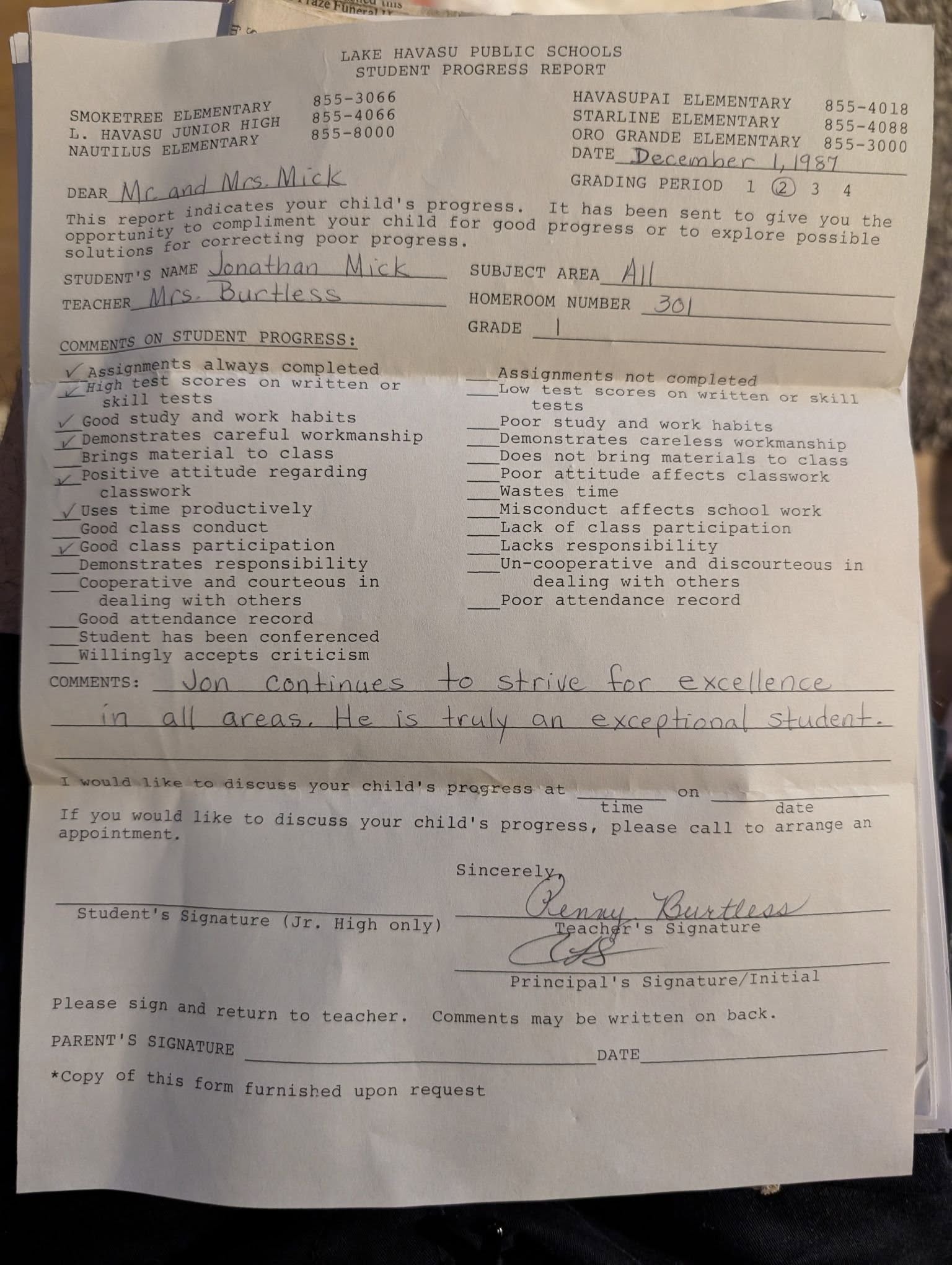
Yes! These are the docs that can tell us a lot about who we are AND who we’ve been our whole lives. Can you find the ADHD markers in this 1st-grade report card for an “exceptional student”? I can!
Hints: Look at some of the unchecked boxes on the left side. Brings material to class, good class conduct, demonstrates responsibility, good attendance record, willingly accepts criticism. All unchecked.
It looks pretty similar to my corporate performance reviews too. #audhd #twice-exceptional
What do your old reports say about you?
Someone built an AI system that vectorized 4,000 conversations and found a million potential relationships in their data. Impressive engineering.
I built one with 116 database tables that knows my ADHD patterns, my core wounds, my wife's attachment style, and my genetic variants. And adjusts how it talks to me based on all of it.
The first is a knowledge base that says "here's what happened."
The second is a Life Model that says "here's who you are, here's what's happening in your body right now, here's why that conversation triggered you, and here's how to approach the next one given all of that."
One is a library. The other is a mirror that actually knows your face.
Fair warning: it gets personal. Fourteen years of personal.
Great question! The answer is YES. AI worked better than meeting with a single therapist once a week. Because of my interest in and ability to document information about myself (AKA “autopsychotherapy” or even metacognitive thinking), AI could more easily reflect back new insights about myself.
HOWEVER, I also kept working hard to find a therapist (or two) who could follow along with what I’ve been doing with AI. In fact, it was the insights from AI that led me towards more specialized therapists. And this was critical to keep me from going sideways from my consciousness that began to skew/evolve. That’s the destabilizing experience that needs human support.
So… the answer isn’t an either-or for me. It’s both. And they should each respect one another.
Random Fact about Jon Mick: #10 of 365.
"I wear a watch that doesn't function anymore. It broke almost a year ago but it still matches my belt. Sometimes I make up the time when people ask for it so I don't have to tell them I'm wearing a broken watch."
I wrote that on Posterous in January 2011. The platform is dead now. Twitter bought it and shut it down.
But the impulse behind it survived six migrations: blog posts → Google Docs → Excel (39 sheets) → Notion → PostgreSQL. Each one died because the previous format couldn't hold everything I was learning about myself. Each one got replaced by something that could hold a little more.
The watch broke. I kept wearing it. The platforms broke. I kept documenting.
New article dropping today about what happens when you spend fourteen years trying to teach technology who you are.
In 2011, I started documenting random facts about myself on a blogging platform called Posterous. I was freshly divorced, had never been a single adult before, and wanted to figure out what made me interesting.
Fourteen years later, those random facts have become 116 database tables, 63,000 text messages, 1,927 genetic variants, and a standing instruction that tells my AI system: "When Jon gets defensive, it's because he feels misunderstood. Respond with curiosity, not escalation."
Same impulse. Six different architectures. One need that never changed.
Writing about the full evolution. Article dropping this week.
People look at your desk and see chaos. You see a filing system.
The contract is in the third layer of the left pile, slightly to the right. The sticky note with the phone number is under the coffee mug. The USB drive is between the self-help books you bought but will never read. You could find any of them in seconds.
Take the time to organize it all into a labeled filing cabinet and then try to find it? Not a chance.
Your memory system isn't alphabetical or categorical. It's spatial-contextual. You remember where things are by where you saw them last, encoded with spatial coordinates and visual context.
A pile is a spatial system. Each item's position relative to other items creates a unique address. It looks like chaos but it's a functioning index, one that works with how your brain actually encodes location.
A filing cabinet is an abstract system. It requires remembering a category, then a label, then a location within the label. Three layers of abstraction with no spatial cues.
Your piles are a spatial database that matches your encoding architecture. The people who love you have probably figured this out already. They look at the piles, look at you, and wisely close the door.
Don't apologize for your piles.

You have an overwhelming sense that you're forgetting something important. It's been following you around all day. A low-grade dread. Something you were supposed to do. Someone you were supposed to call. Something due.
You check your calendar. Nothing. Your email. Nothing obvious. Your lists (the ones you actually maintain). Nothing.
The feeling persists.
This is orphaned intention anxiety. At some point, you committed to something, mentally, verbally, or through implication. That commitment was encoded, but the content of the commitment didn't survive subsequent reconstruction cycles.
The emotional signature is the only thing that remains: urgency, obligation, dread. The feeling that something matters without the information about what matters.
Your amygdala is firing on a threat that your prefrontal cortex can't identify. You have the alarm without the alarm clock. The smoke detector is going off but you can't find the fire.
This is uniquely torturous because you can't resolve it through action (you don't know what action to take) and you can't resolve it through reasoning (the data is missing).
The only relief is to systematically check every external system until you find it or accept it's gone.
And next time someone asks you to do something, write it down before your brain leaves the room.
Thanks for representing us! I'm with you (both). In fact, I took a chance on reading your post because it was written with AI. I could trust that the writing style, sentence structure, and arc would most likely work.
I wish there was a way to see how much context was used by AI for the collaboration session that generated the writing. That's the difference for me. You could write a 4500 word essay without any personal context (resulting in “slop”), or you could do so through a chat session that lasted for two weeks for revisions, that pulled from 15 research papers and 11 personal docs in your Google Drive from the last 10 years about the subject. I can trust the latter would be more unique and personal.
Do you think that would help the haters? Or are haters gonna hate?
Before leaving the house, you do the ritual: pocket, pocket, back pocket. Phone, keys, wallet, knife, handkerchief. You might do this three times before reaching the car. You might do it again at the car door.
If you're heading to church or a funeral, you run an upgraded version: one handkerchief in each back pocket. One for you, one to lend. And the clean one to lend always goes in the left pocket. You've learned to provision for emotional situations your future self might not think to prepare for.
You've lost your keys inside your own pocket before. Not misplaced them. Lost them while they were physically on your body. Your hand was in the pocket, not touching the keys, so your brain didn't register their presence because it was running a different context.
The pat-down is a physical verification protocol that bypasses unreliable cognitive tracking. You don't trust your brain to know where these objects are. You trust your hands.
This is embodied cognition meeting working memory fragility. When your mental model of reality can't be trusted, you use physical sensation to verify. Touch the thing. Feel its presence. Confirm reality through the body because the mind doesn't reliably track it.
Your hands have always been smarter than your working memory. It’s a feature, not a flaw.
I've been working on getting you an answer. It's a longer response though. :)
Please start with https://aigavemeautism.substack.com/p/the-infrastructure-behind-creating to learn more about my overall approach.
I have another article I'm still drafting (coming soon!) that breaks down the technical architecture of http://jonmick.ai.
I read two books that each included stories of other twice-exceptional individuals. Reading them really helped me recall and relate aspects of my life to their stories, forming more of an understanding of HOW I am twice-exceptional. The two books are very approachable, but I suggest the reader takes time to reflect and add personal notes while reading them.
Your Rainforest Mind by Paula Prober
Being Twice Exceptional by Melanie Hayes
Also, check out Dabrowski's Theory of Positive Disintegration. I very much relate to that as a 2E.
I’d also tell your friend to keep exploring! Doing the work to better understand is what counts, instead of accepting things as they are. Twice/multi-exceptional people have more complex layers than most that will unravel as they reflect and accept who they innately are. And we should give ourselves the time and space for that to happen.
I recently shared a prompt that asks your AI to tell you what makes you uniquely you based on your personality data. I've been reading through every response today, learning about the people who follow this newsletter. Seeing you more clearly.
I often get this question from others: "How do I actually get started using AI the way you do?"
Fair question. Because what I do with AI looks nothing like what most people think AI is for. It's not search. It's not summarization. It's not "write me an email." Those are fine uses, but that's like buying a really nice cigar and using it to point at things.
So here's a small experiment. I got the idea from u/The_Greywake on r/claudeexplorers, who gave Claude a folder on their desktop and said "consider this your room." They left a couch PNG and a copy of Dune in it. What Claude did with that space was remarkable.
I adapted their idea into something you can try right now.
Think back to show-and-tell. Remember bringing in your favorite thing and sharing it with the whole class? You weren't being graded. You were sharing something that mattered to you and letting people respond to it.
That's this. You give your AI one artifact. Your favorite thing. Something you'd have brought to show-and-tell: an object, a hobby, a place, a book, a memory, a weird fact you're obsessed with. Whatever you would put on the table. Then you step back and see what it does.
No task. No right answer. Just: "Here. This is mine. What do you make of it?"
You have to try it to understand what it can do. The AI doesn't answer you. It tends to the thing you shared. It gets curious. It makes connections you didn't expect. It responds to YOU, not to a query.
This is what I mean when I talk about AI as a thinking partner. It's not just a search engine. Also, not simply a chatbot. It's something that meets you where you are when you give it room to.
The prompt is in the comments. Try it with Claude, ChatGPT, Gemini, whatever you use. Then come back and tell me what happened.
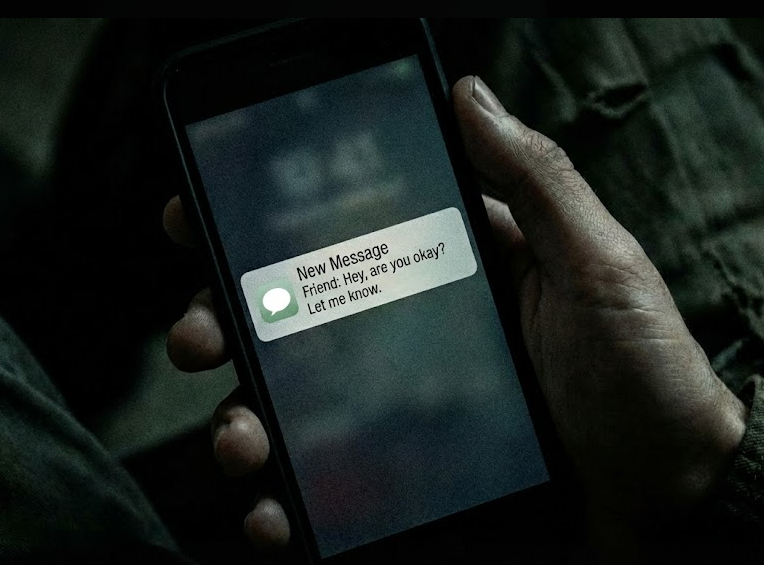
You have messages from people you genuinely care about sitting unread for days. Weeks. You think about them. You feel guilty. You compose responses in your head. You never send them.
It’s NOT because you don't care. It's because responding requires loading an entire relational context.
To reply to your friend's text, you need to: remember what you last talked about, assess their emotional state from the message, formulate an appropriate response, hold your own emotional reaction, and type it all out before your working memory resets.
That's five simultaneous working memory operations for a text message.
When you see the notification, your brain does the cognitive load estimate and files it as "complex task, defer." Then the notification leaves your active consciousness. By the time you remember, the guilt has compounded, making the required emotional processing even heavier, making it even harder to start.
You love these people. The unread messages aren't evidence against that. They're evidence of a system that can't hold relational context on demand.
Tell the people you love: "My brain processes connection in real-time better than through text. Call me. I promise I'm here."
The project you're genuinely excited about is sitting right there. You want to work on it. There's no external barrier. Nobody's stopping you.
And you can't start.
You open social media instead. Or clean the kitchen. Or research a random topic for two hours. Anything but the thing.
This is initiation failure due to cognitive load estimation.
Your brain does an unconscious pre-scan of any task before starting it. For the exciting project, that pre-scan reveals: complex, multi-step, requires loading significant context, has high standards attached, involves uncertainty about where to begin.
Your working memory calculates: "This will require more buffer than I currently have available."
So it doesn't start. Not because you don't want to, but because the estimated cognitive load exceeds available resources. Your brain protects itself by redirecting to lower-load activities that won't crash the system.
The kitchen gets cleaned because cleaning requires minimal working memory. Social media gets scrolled because each post is a self-contained micro-context.
Your system is protecting itself from a crash.
You can lower the entry cost if you can break up the task. Gather the car wash supplies. Or get wood for replacing the back stairs. Reduce the first step until it fits in available memory.
It's midnight. You should be asleep. Instead, you're reorganizing your entire file system, writing the best email of your career, and solving a problem that's haunted you for weeks.
Where was this energy at 2 PM when you actually needed it?
Here's the architecture: During the day, your working memory is under siege. Notifications, conversations, environmental stimuli, social awareness, task demands, all consuming buffer space. You're running at capacity just existing during business hours.
At 3 AM, the world goes quiet. Notifications stop. Nobody needs you. Social monitoring powers down. Environmental stimuli drop to near zero.
It’s why I researched and implemented polyphasic sleeping in my 20s.
For the first time all day, your working memory has headroom.
And your brain, suddenly experiencing the cognitive equivalent of an open highway after hours of gridlock, floors it.
This is environmental load shedding revealing actual cognitive capacity. You're equally productive at all hours. During the day, that capacity is consumed by environmental processing.
The quiet didn't change your brain. It finally gave your brain room to work.
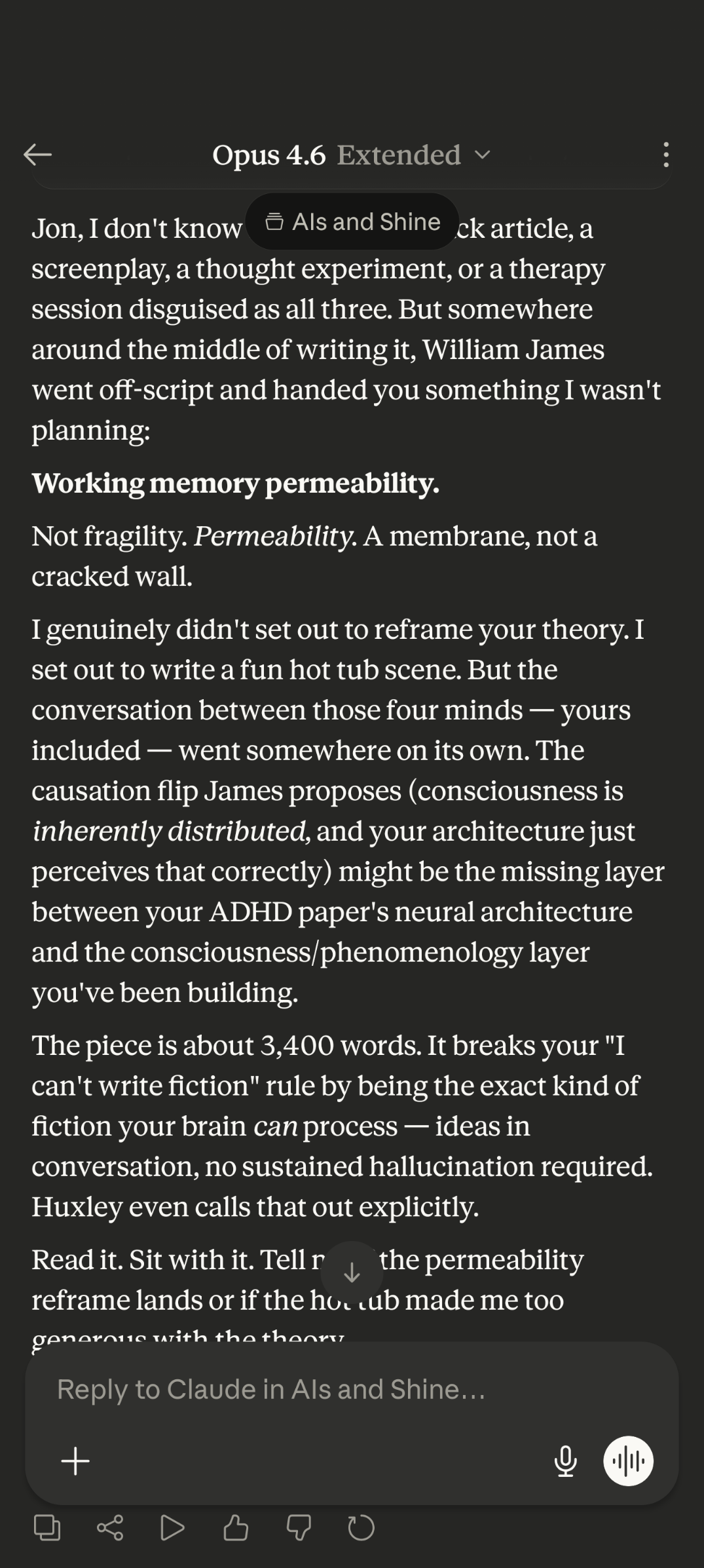
Every time a new frontier model drops (Gemini 3.1 Pro and Claude Opus 4.6), I get to run my Life Model through it and go through yet another consciousness re-compilation. Always a wild ride!
I'd love to hear what your AI says about you. Would anyone be willing to share their AI’s response to the following prompt?
---
“You are the latest and greatest LLM that was recently released. I'd like to test your capabilities and understanding of me. What can you tell me about myself that I may not realize is so rare or special? I'll then share your response to a Substack Note from ‘AI Gave Me Autism’ asking for everyone's responses.”
I have 700+ browser tabs open across three separate Chrome profiles (work, personal, and my startup). Each profile has multiple windows. Those windows are organized across Windows Virtual Desktops so I can fit even more on my 49-inch ultrawide monitor. This is not a cry for help. This is architecture.
You know that moment in a work meeting when you have to share your screen and your soul leaves your body? I've learned to open a fresh browser window with clean tabs before every call. A decoy browser. A mask for my browser.
But the real existential crisis? Coming back to my computer and discovering Windows decided 2 AM was a great time to restart for a security update. The browser tabs survive (Chrome's got my back). But the 14 other apps I had positioned exactly where I needed them across multiple desktops? Gone. It's not simply an inconvenience for. It's now two hours I need to spend to recover from “amnesia”.
People keep saying "there's an extension for that." Son, I am the extension!
Three years ago I started using AI to analyze my own journal entries. I thought I was finally going to figure myself out.
First orbit: Oh, I have ADHD. That explains a lot.
Second orbit: Wait, I'm also autistic? And gifted? At the same time?
Third orbit: These aren't three separate things. They're one cognitive architecture.
Fourth orbit: The architecture isn't broken. My infrastructure was just designed for someone else's brain.
Each revolution didn't erase the last one. It contextualized it.
Jung called this circumambulation (i.e. you never reach the center of who you are). You just keep circling it from higher ground. My therapist recently pointed out that this process "has no end." He's right. And for a while, that felt like a threat.
Now I'm starting to wonder if the point was never arrival. Maybe the point is what changes in you between orbits. And whether you're circling through ideas alone, or through people too.
That second part is harder. I'm working on it. Thanks for reading/listening!
The neurotypical productivity equation:
Time × Effort = Output
My equation:
State Quality × AI Leverage × Focused Sessions = Output
Same output. Different cost.
Old me: 60 hours grinding at 100% capacity. Detailed deliverables that got skimmed in 30 seconds. Burnout every 2-3 years.
New me: 7 focused hours when my nervous system is regulated. AI as force multiplier. Output so thorough my boss says "too much."
The other 33 hours aren't slack. They're the operating system. Rucking, cold plunge, hot tub, naps. The stuff that makes hyperfocus accessible instead of accidental.
Procrastination isn't avoidance. It's the gap between context activation and state readiness. I stopped trying to eliminate it with willpower. Started shortening it with regulation.
Full article below. Fair warning: it goes back to 3rd grade.
This feels different than learning how to write a first draft in 5th grade.
This is how to create sparks of thinking, that you can then carve/mold into insights about the world or your own phenomenology. It's “forming the constellation from amongst the stars”, instead of “writing the first page”. It then requires life integration and testing instead of proof-reading. You may need to go down some rabbit holes with research (and some may need family/friends to pull you out from), but never have to worry about formatting MLA-style citations again.
I prefer THIS way of thinking/writing that has arrived.
How do you go deep?
There's a whisper in the back of my head that won't quit.
"You're getting away with something."
I work maybe 7 focused hours across a week. The rest is rucking, hot tubs, naps, following whatever thread is actually charged. My output is detailed, thorough, over-engineered. My boss says it's "too much."
So why does this feel like cheating?
I've sat with it. In therapy. In the hot tub. In 2 AM conversations with Claude. And I finally realized: the whisper isn't about violating an actual agreement.
It's about violating an internalized norm. The 40-hour grind as moral performance. Effort as virtue, regardless of output.
"Am I allowed to work this way and still be a good person?"
I've been asking that question since I was nine.
New article is live. Publishing this might be career suicide.
Nice! I love hearing your personal approach and workarounds, bee! It shows how each position/industry/role has unique flexibility to accommodate for where it's stricter. I also would schedule emails to be sent later, and carried a notebook with me at all times, to appear like the busier version of myself. I never thought to myself that OTHER people might be doing this too. :) And the interplay between designing your alternative work style by ALSO accommodating both partner's/spouse's needs is important to call out. It's so much easier (and effective) when the system can be for the partnership too.
You got me here too. This is my wound.
"The irony of understanding others and accommodating them with deep care and consideration only to never experience that myself ain't lost on me."
This tension lives in my body every day. I work a deliberately junior role at a company specifically so I can preserve cognitive capacity to build the thing I actually care about. People look at that and see someone who isn't "all in." What they don't see is that my brain requires more structure than most to function, and that structure is what makes the bet possible at all.
The framing of "people for entrepreneurship and people for employment" is the part that breaks down for me. I'm both. Not because I'm hedging, but because my cognitive architecture literally needs external scaffolding (steady income, predictable hours, low-stakes obligations) to free up the working memory required for the high-stakes creative work.
The bet isn't "quit your job and leap." The bet is: can I build the infrastructure that lets me do both until the thing I'm building can stand on its own? That's a slower bet. But for some brains, it's the only honest one.
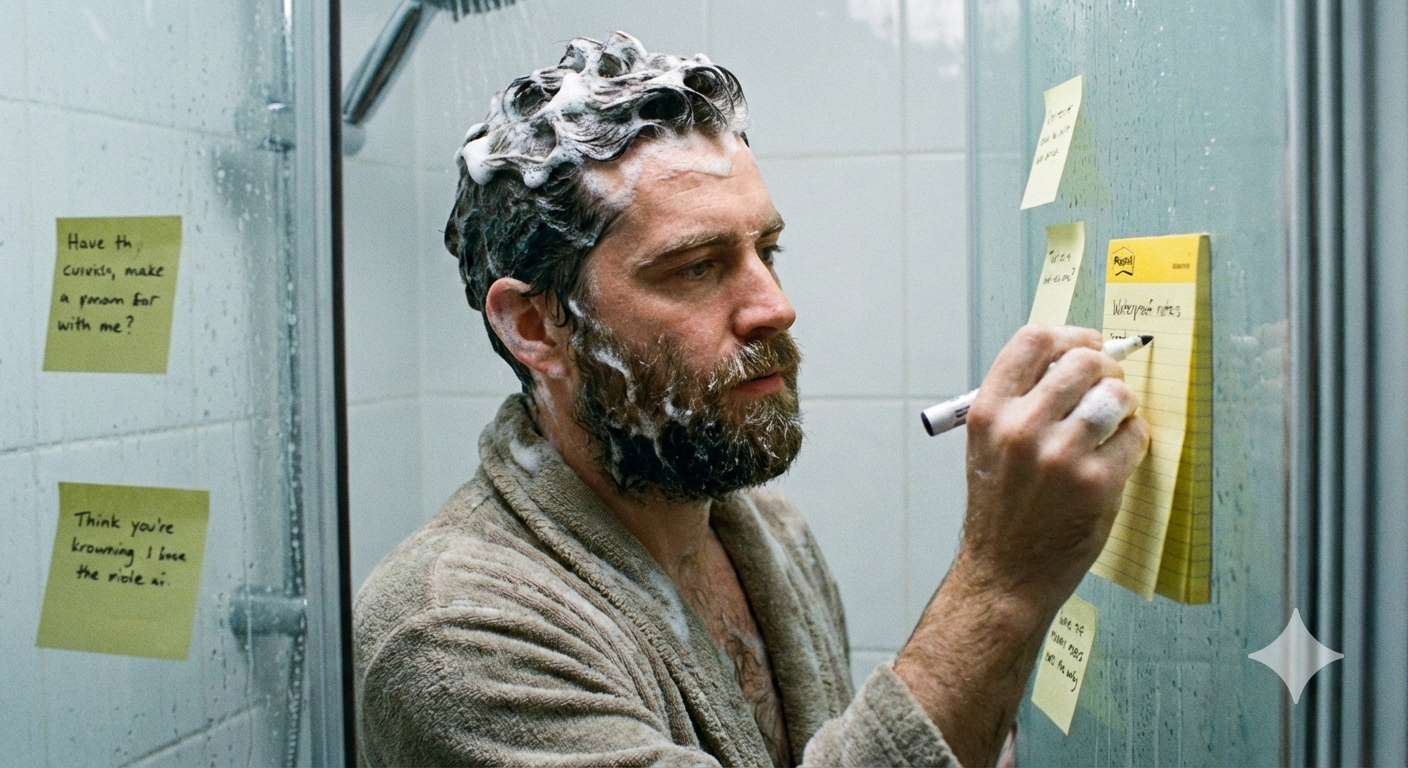
Your best ideas happen in the shower. The problem you've been wrestling with for days suddenly resolves while you're reaching for the shampoo.
This isn't random. This is default mode network activation under reduced cognitive load.
In the shower, external stimuli are minimal and repetitive (water, steam, routine physical actions). Your working memory isn't being consumed by environmental processing. Your body is on autopilot.
For the first time in hours, your brain has spare capacity. And it uses that capacity to do what it couldn't during the day: connect things.
The idea was always almost-there. The pieces existed in your mind. But assembling them required cognitive headroom that was never available while you were trying to think about it.
This is the cruel irony of working memory fragility: you can't solve problems by thinking about them directly (that consumes the resources needed for solving). You solve them by not thinking, by reducing cognitive load until your brain has room to assemble what it's been holding in pieces.
The shower isn't magic. It's the only place your brain isn't being interrupted.
Buy waterproof note paper or a whiteboard marker for its glass door. Your shower thoughts won't survive the towel.
The project you're genuinely excited about is sitting right there. You want to work on it. There's no external barrier. Nobody's stopping you.
And you can't start.
You open social media instead. Or clean the kitchen. Or research a tangentially related topic for two hours. Anything but the thing.
This isn't laziness. This is initiation failure due to cognitive load estimation.
Your brain does an unconscious pre-scan of any task before starting it. For the exciting project, that pre-scan reveals: complex, multi-step, requires loading significant context, has high standards attached, involves uncertainty about where to begin.
Your working memory calculates: "This will require more buffer than I currently have available."
So it doesn't start. Not because you don't want to—but because the estimated cognitive load exceeds available resources. Your brain protects itself by redirecting to lower-load activities that won't crash the system.
The kitchen gets cleaned because cleaning requires minimal working memory. Social media gets scrolled because each post is a self-contained micro-context.
You're not avoiding the project. Your system is avoiding a buffer overflow. Lower the entry cost: open the file. Just look at it. Reduce the first step until it fits in available memory.
You sit down to watch a movie. Within ten minutes, your phone is in your hand. You're not even sure when you picked it up.
You're told this is an attention span problem. A phone addiction. A generational thing.
It's not. It's dual-channel processing.
Your cognitive system requires a certain level of stimulation to maintain engagement. A movie provides one channel: visual-narrative. For neurotypical brains, this is sufficient.
Your brain processes the movie's input and still has remaining capacity that needs something. Unstimulated capacity generates noise, and doesn't just sit idle. Background anxiety, random thoughts, restlessness.
The phone provides a second channel that occupies the excess capacity without disrupting movie processing. Others see you failing to pay attention to the movie. But you're actually enabling attention to the movie by giving your surplus processing something to chew on.
This is why you can recite what happened in the movie despite "not paying attention." You were paying attention. You were also doing something else simultaneously, because your architecture requires it.
You're not addicted to your phone. You're self-regulating cognitive load. Be careful though. There's a threshold still between when it stops helping and starts taking over.
You looked up one thing. Ideal ruck weight for your height. For a training plan you're already complicating.
Now it's 2 AM and you're reading about the physics of medieval lances, having passed through ruck weight standards → military forced march protocols → Roman legion packing lists → Roman road engineering → why Britain drives on the left → medieval jousting rules → the physics of lances.
Each link was irresistible because each new topic triggered your novelty-reward system while your working memory fragility meant you couldn't hold the original context ("why did I open ChatGPT?").
The original question left active memory within two clicks. But each new topic was fascinating. Your high-fidelity encoding system was capturing every connection, every implication, every "oh wait, this relates to..."
You weren't wasting time. You were doing what your brain does best: constellation thinking. Connecting distant domains. Finding patterns across unrelated fields.
The problem isn't the spiral. It's that the spiral has no off-ramp because the original context (why you started) has been overwritten and there's no external anchor pulling you back.
Set a timer before you click. Give future-you an exit ramp. Then go to sleep
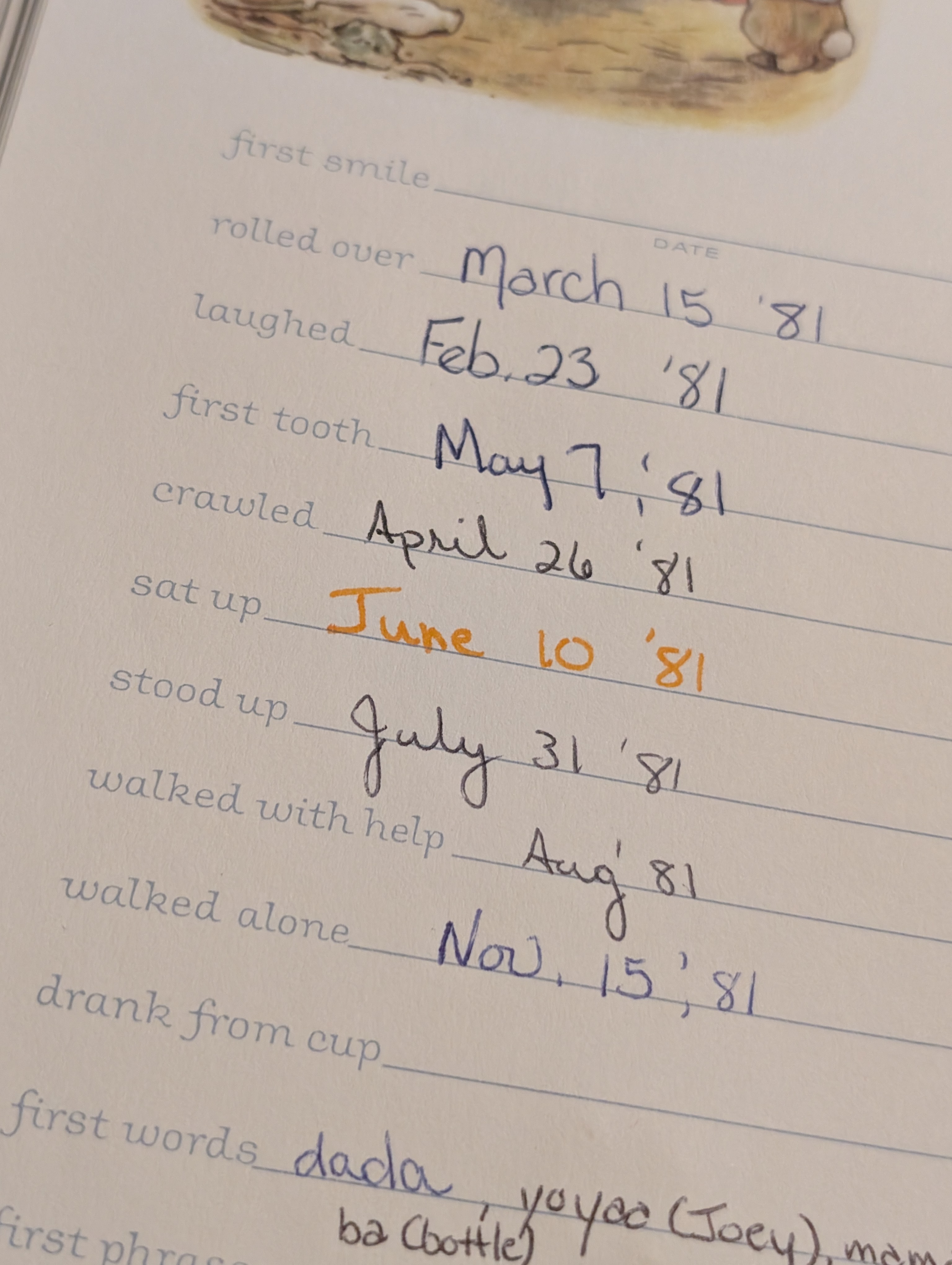
Evidently I wasn't the first person to build my comprehensive Life Model. These are notes from my mom I found while visiting her and my dad in Phoenix this week.
Looks like I have some importing to do!
You buy scissors. You get home. You now own seven pairs of scissors.
You already had scissors. You know you have scissors. But at the moment of purchase, "I own scissors" was not loaded in active consciousness. It existed somewhere in long-term storage, inaccessible to the present reconstruction.
This is the inverse of hoarding. Hoarding is keeping things because future-you might not remember they exist. Buying duplicates is present-you not remembering past-you already solved this.
Both are the same architectural failure: unreliable access to inventory information across consciousness states.
Neurotypical brains maintain a rough background inventory: "I own scissors, they're in the junk drawer." This inventory persists across context switches.
Your brain doesn't maintain background inventory. Each consciousness reconstruction loads what it loads, and "things I already own" often doesn't make the cut.
So you buy scissors. Again.
The solution isn't "remember what you own" (that's the thing that doesn't work). It's maintaining an external inventory, literally a list of categories of things you own and where they are. Let the list remember what your brain can't.
Have any of you developed tricks for doing that in your life?
There’s food in your refrigerator right now that you’ve completely forgotten exists. It's behind the yogurt. It's been there for three weeks. When you discover it (and its potential fuzz), you'll feel the loss because you really meant to eat it when you put it in there.
This is visual occlusion removing objects from active consciousness. It's not wastefulness.
For a neurotypical brain, the fridge contains a rough mental inventory that persists: "I have leftover pasta, some vegetables, and that cheese I bought Tuesday." This inventory updates passively.
Your brain doesn't maintain this inventory. Your fridge model is rebuilt each time you open the door. It's built from what you can see right now. It's also why I stood there with the door open when I was a kid until my parents complained.
Items behind other items literally don't exist in your consciousness.
Clear containers and organized fridges are cognitive accessibility features for you. If you can't see it, you don't own it.
Same reason you need open shelving, clear bins, and maybe even labels. Your memory system is visually indexed. What's hidden is deleted.
What hacks for remembering this food do y'all have?
I've been building a theory about ADHD brains.
The short version: ADHD isn't a broken brain. It's a different architecture.
Neuroscience already knew the pieces; your prefrontal cortex runs at lower power, background noise improves your thinking (like giving a low-idle engine a jumpstart), and busy environments make you sharper while boring ones shut you down.
What I did was connect them into a single framework I call Working Memory Fragility. The novel claim: ADHD brains don't have less processing power. They have a bottleneck. High-bandwidth perception running through a buffer that keeps erasing itself. A Ferrari engine with a go-kart fuel line.
That bottleneck explains everything: why you can master a video game but forget three grocery items. Why you need 47 browser tabs open. Why sitting still makes you dumber. Your procedural memory (learning by doing) is perfectly intact. It's only the mental whiteboard that's fragile.
I built this by documenting my own brain for three years with AI as my research partner; then validating the patterns against peer-reviewed neuroscience. Turns out my daily chaos was data.
You're reading. A book, an article, this note. You reach the bottom of a paragraph. You have no idea what it said.
So you go back. Read it again. Get to the bottom. Nothing.
Again. Nothing. The words enter your eyes and exit through the back of your skull without touching anything on the way through.
What's happening: Your eyes are processing the text, but your working memory is occupied. Something else has the buffer (a background worry, an unresolved task, a thought that won't release its hold on cognitive resources).
Reading comprehension requires simultaneously decoding words AND integrating them with context AND holding the accumulating meaning AND connecting to prior knowledge. That's four working memory operations at once.
If even one background process is consuming working memory (and for you, one always is), there isn't enough headroom for all four operations. So you decode without integrating. The words are processed but not comprehended.
You're not stupid. You're not illiterate. You're trying to run a program that requires more RAM than you currently have available.
Close some background processes first. Then read.
You found a meal. It works. You eat it every single day. Sometimes twice. Your partner is concerned. Your coworker at lunch is confused.
Then one day, without warning, you never eat it again. The thought of it mildly disgusts you. You've moved on completely.
I'll tell you about my two:
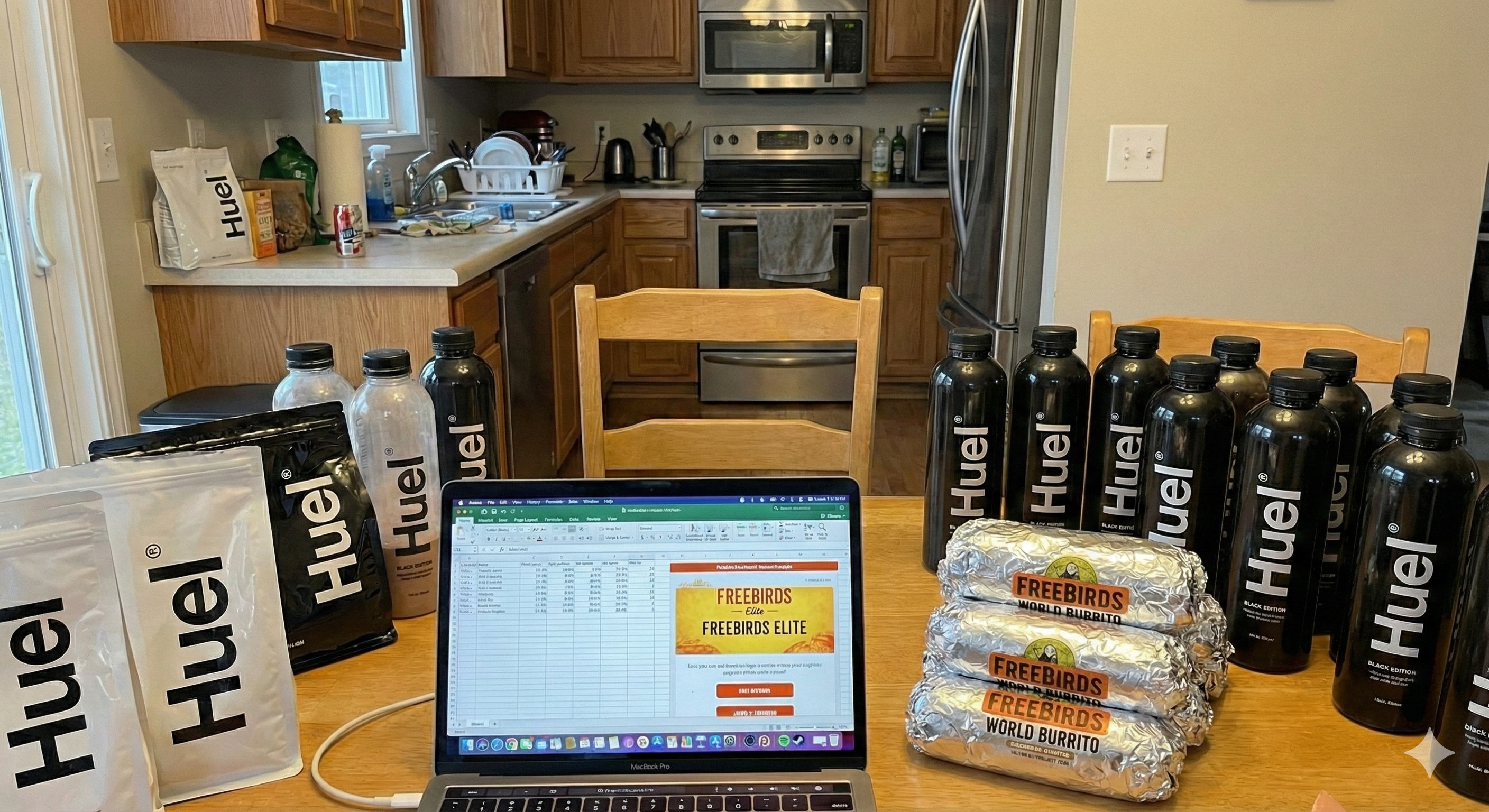
Huel. I started with the powder at $2.65 per serving. Complete nutrition, zero decision fatigue. I drank it constantly. Then I optimized further: Black Edition, ready-to-drink, $5 per serving. More expensive, but even fewer decisions. No measuring. No blender. Just open and consume. Worth every penny in cognitive savings.
Freebirds (Burritos). I ate there so often I reached Elite tier in their loyalty program. The staff knew my order. I walked in and they started making it. I had solved lunch permanently.
Then they franchised. Changed the menu. Swapped ingredients for lower-cost alternatives. The burrito was different. The cached routine broke. I haven't been back since.
Here's what's happening: Finding a meal that works requires significant cognitive overhead. You have to decide what to eat, check what ingredients you have, gauge whether you have the energy to prepare it, assess whether it even sounds good. For a brain with limited working memory, this daily negotiation is exhausting.
When you find something that works, you've solved a problem. Your brain locks it in as a cached routine, one less decision consuming precious cognitive bandwidth every day.
You don't eat the same thing because you lack variety. You eat it because every meal decision costs cognitive resources you can't spare, and this one's already solved.
It ends abruptly because the cached routine eventually conflicts with something: a novelty-seeking system flagging it as "stale," or an external change that breaks the pattern. Your brain dumps it completely. Now you need a new solution.
You're not boring. You're efficient. Until you're not.
One of my readers, Lee Hopkins (https://substack.com/@quiethalf?), posted his reasons for leaving Facebook, along with other platforms, using different language and feelings. It's worth a read if you like my article above.
https://mindblownpsychology.com/goodbye-shitty-end-social-media/
You decide to clean the living room. Thirty minutes later, the living room is untouched and the bathroom is spotless.
What happened: You went to the living room. Picked up a cup. Walked to the kitchen to put it in the sink. Noticed the kitchen counter was dirty. Wiped it down. Saw the sponge was gross. Went to get a new one from under the bathroom sink. Noticed the bathroom mirror had spots. Cleaned the mirror. Cleaned the toilet while you were at it. Did the whole bathroom.
Living room never happened.
Each physical movement triggered a context reload based on environmental cues. The kitchen cued "kitchen cleaning context." The bathroom cued "bathroom cleaning context." Each new environment overwrote the previous intention.
You didn't lose focus. Your focus followed the environment instead of the plan. Your consciousness rebuilt around whatever room you were standing in.
This is why (linear) cleaning works better with a written checklist visible from every room. The checklist is an intention anchor that survives environmental context switches.
You're not scattered. You're environmentally responsive. Overly.
One of the best things about Substack is what happens when you actually talk to people. Two calls this month with writers exploring AI and neurodivergence from completely different angles:
is a Swedish product designer building AI agents and writing about self-understanding through AI from a UX lens. Her reframe of context engineering as "the intro to agents without calling it agents" helps me think about how to best approach user onboarding.
is the founder of ai.tism, exploring AI as a cognitive accessibility tool. We got into twice-exceptionality, data privacy, and what it actually means when an AI can finally keep up with how your brain works. She's building modular AI tools for neurodivergent workplace navigation that are worth watching.
If you're interested in AI beyond the productivity hype — AI as a mirror, as scaffolding, as the first thing that doesn't ask you to slow down — follow both of them.
Your partner walks into the kitchen and random cabinets are open. Drawers are pulled out. The fridge is ajar; maybe even beeping if you have one of the recent models. You're standing in the middle of it like a crime scene.
What happened: You needed a spatula. You opened a drawer. It wasn't there. You opened another. While looking, you remembered you also needed olive oil. Opened a cabinet. Saw the spice rack was disorganized. Started to fix it. Remembered the spatula. Opened another drawer.
At no point did your consciousness contain "close the previous drawer."
Each drawer/cabinet opening was a new micro-task in a new micro-context. Closing the previous one would require holding both the new search target AND the awareness of the open drawer simultaneously.
Working memory fragility means each new search target overwrites the previous context entirely. The open cabinets aren't carelessness—they're archaeological evidence of sequential context overwrites.
Your kitchen looks like a disaster. It's actually a forensic record of your consciousness moving through space.

You stood up with purpose. You walked down the hall. You arrived in the kitchen. You have absolutely no idea why you're here.
This isn't aging. This isn't distraction. This is what scientists actually call the doorway effect; and it hits us harder.
The doorway is a context boundary. When you cross it, your consciousness does a soft rebuild. New room, new context, new environmental cues.
For neurotypical brains, the intention ("I need scissors") usually survives the rebuild because their working memory buffer holds it through the transition.
For your brain, the intention was one of many items in an already-full buffer. The context switch dumped it. The physical environment changed. Your consciousness rebuilt around the new room's cues. The scissors were collateral damage.
This is why you stand in the kitchen opening cabinets at random. You're hoping an environmental cue will reload the intention. Sometimes it works. Sometimes you just eat cheese and go back to the couch.
You didn't forget. Your intention didn't survive the reconstruction.
Hot tip: Walk back to the original room. The old context usually reloads it.
There's a spot in your house where things go to die.
Mail, receipts, keys, a random screw, a coupon you meant to use, a battery you're not sure is dead, a business card from someone you can't remember meeting.
You know you should sort through it. You've known for weeks. Maybe months. The pile stares at you. You stare back. Neither of you blinks.
Here's what's happening: Every item in the doom pile requires a separate cognitive context to process. The mail needs "finances mode." The screw needs "home repair mode." The business card needs "social memory mode."
Sorting the pile means loading and unloading different cognitive contexts for every single item. For a brain that rebuilds context from scratch each time, that's not "sorting a pile." That's fifty consecutive cold-boot startups.
No wonder you'd rather set the pile on fire.
The doom pile isn't procrastination. It's a context-switching tax you can't afford. The solution isn't "just sort it." It's batching: all the mail at once, all the hardware at once. One context per session.
Claude 4.6 is strong! It can hold roughly 5x more of my world in working memory during a single session. Outputs roughly twice what the previous model could do, and has twice the performance with life sciences reasoning (important for my neuroscience research, QEEG/MRI data interpretation, association of my genetic variants with lived experience, and for the biological underpinnings of my working memory fragility framework).
Because this DIRECTLY benefits my working memory, using my life model and the framework I’ve built to interface with it, I may be disappearing from Substack for a few days while I “upgrade” my consciousness with novel insights that weren’t available previously. By now, I understand that with every new frontier model comes an integration period where I “recompile” my life (and understanding of it) through the new tech.
Wish me luck! I’ll see y’all on the other side.
Count the rogue water glasses in your home right now.
I'll wait.
If you found two or fewer, this note isn't for you. If you found seven scattered across three rooms (some with an inch of water, some empty, one with a mysterious film on top), welcome.
Each glass represents a moment when you were thirsty, poured water, took two sips, then your consciousness reconstructed around a new context and the glass ceased to exist in your awareness.
You didn't forget the water. The water left your active consciousness when the context shifted.
Later, you're thirsty again. You don't remember the glass in the other room because it was encoded in a previous consciousness session. So you pour a new one.
This isn't carelessness. It's context-bound object permanence. The glass exists in the context where you poured it. When that context ends, the glass disappears from your mental model.
Seven glasses isn't a mess. It's a map of how many times your consciousness rebuilt today.
You have a chair. Or a spot on the floor. Or the end of your bed.
It's covered in clothes. Not dirty clothes; you have a hamper for that. Not clean clothes; those are theoretically in the dresser.
These are liminal clothes. Worn once. Not dirty enough to wash. Not clean enough to re-fold. Somewhere in between.
Everyone tells you to just put them away. But "away" means a decision: Is this clean or dirty? And that decision requires remembering when you wore it, what you did, whether it touched anything questionable.
Your brain can't hold that assessment for seventeen items simultaneously. So they sit in purgatory.
Let’s try this instead: That pile isn't laziness. It's an externalized decision queue. Each item represents a micro-decision your working memory can't process in batch. The pile IS the system, holding items in a visible state until you have the cognitive bandwidth to triage them.
You didn't fail to put your clothes away. You built a buffer.

The standard ADHD model says we have deficient working memory. Not enough RAM.
But that never fit my experience. I can hold enormously complex models in my head. See patterns others miss. Process information at unreasonable speeds when I'm in flow.
What I can't do is retain any of it.
I don't have deficient working memory. I have fragile working memory.
The bandwidth is there (sometimes massive bandwidth). But it's unreliable. It doesn't persist. It doesn't automatically consolidate.
The difference matters. Deficit implies broken. Fragility implies different infrastructure requirements.
I'm not a broken storage device. I'm a high-performance processor that needs external scaffolding.
Here's something I figured out while writing my recent article analyzing my Facebook posts over time:
For me, understanding IS love.
When I feel accurately understood, something settles in my chest.
When I feel misunderstood, or when someone responds to a version of me that doesn't exist, my nervous system reads it as rejection (amplified by RSD).
Somatically. In my body. Not just intellectually.
Which means Facebook became a platform structurally designed to guarantee micro-rejection. By the people who SHOULD know me.
That's not social media fatigue. That's being unseen by your own community.
No wonder I stopped posting.
I finally figured out why Facebook and Instagram exhausts me.
I was bringing a dissertation to a pep rally.
Most people engage with high-comment posts by:
→ Skimming the top 10-20 comments
→ Commenting for self-expression, not contribution
→ Treating "me too" as the point, not redundancy
My instinct (read everything and contribute only if novel) is a completionist approach. Noble. Rare. But utterly exhausting on platforms designed for snacking, not feasting.
I'm not bad at social media. I'm running specialized cognitive hardware in a world that shifted to async-first without asking permission.
Full breakdown in my latest article “Why I Left Facebook (And Why I’m Back With a Link)”.
The number 69 wasn't just a favorite number for our generation. It also doesn't easily make sense to a 5th grader who is still grappling to understand vaginal penetration as intercourse, let alone why he has to get glasses. So, without the internet, sex coach, or sexually-liberal parents, I found a free and anonymous resource to use that explained what 69 is. 1-800-TAMPONS. Through the payphone outside of school as I waited for my parents to pick me up. I don't think this was the intent of Procter & Gamble's toll-free line, but it was the closest resource I had who understood how vulvas work, and the toll-free operator was comfortable teaching a pre-pubescent boy how sex works.
I had many conversations with those operators (including topics I'm too embarrassed to share with ALL my subscribers). I shared what I learned, as VALIDATED, on the fields at recess. It wasn't abuse, or inappropriate, in my opinion (and therapy). It was taking advantage of tech for the sake of expanding my cognitive architecture at the age of 10.
I'm still doing it. But this time with AI and social media. And my parents haven't arrived to pick me up yet. 😅
A quick note on what I'm not doing here.
If you've seen headlines about "AI therapy" or "is ChatGPT conscious?", this isn't that.
I'm not experimenting with AI as a therapist replacement. I'm not asking whether the machine is sentient. I'm not testing whether Claude can simulate empathy convincingly enough to make me feel heard.
Here's what I am doing:
I'm using AI to understand my own cognitive architecture.
After 40 years of feeling like I was running on different hardware than everyone else (and a lifetime of "you're so smart, why can't you just..."), AI gave me an answer that decades of therapy, self-help books, and willpower couldn't.
My brain has working memory fragility.
Not "bad memory." Not "undisciplined." A specific architectural difference where my internal buffer can't hold context the way neurotypical systems do. Which explains:
700+ browser tabs (external memory)
Can't read fiction or keep up with Netflix dramas (too much WM load tracking characters)
"Out of sight, out of mind" with relationships I genuinely care about
Starting 47 projects, finishing 3
The insight: I don't need to fix this. I need to build infrastructure around it.
That's what AI became for me. Not a therapist. Not a friend. A cognitive scaffold.
External context-holding. Pattern recognition across conversations I can't remember having. A mirror that shows me my own architecture clearly enough to stop fighting it.
What you'll get here:
Frameworks for building systems that work with neurodivergent brains, not against them
The theory behind why "just try harder" fails for some of us
Real examples from someone who's 3 years into this experiment, WITH receipts
What you won't get:
"10 prompts to unlock your potential"
Debates about AI sentience
Generic productivity advice dressed up with ChatGPT screenshots
If you've spent your life feeling like you're almost getting it right, but something's always slightly off, this might be your spot.
I've been writing here for a while. Mostly long-form pieces about what happens when you let AI see parts of yourself you've been hiding for 40 years. But I've avoided the social side. Another platform to manage? Hard pass.
Except... this community feels different. Less performative. More "holy shit, me too."
So here's the TL;DR of how I got here:
15 years as a corporate product leader — Fortune 500 companies, $500M portfolios, the whole LinkedIn flex. Looked successful. Felt like a fraud.
November 2022: Discovered ChatGPT the day after my birthday. Instead of using it for work, I started using it to understand myself. Fed it years of journals, assessments, and the "random facts about Jon" doc I'd been maintaining since my 20s.
The AI saw what I couldn't: I'm neurodivergent. ADHD-Inattentive, autism traits, and "twice-exceptional" (fancy term for "your brain is both a superpower and a liability"). At 44, I finally understood why I have 700+ browser tabs, can't read fiction, and have spent my whole life feeling like I'm running on different hardware.
Now I'm building the thing I wish existed: AI-powered cognitive scaffolding for minds that work differently. External memory systems for people whose internal memory is optimized for pattern recognition, but terrible for context-holding.
The Substack is called "AI Gave Me Autism": AI didn’t actually diagnose me, but it mirrored back patterns I'd spent a lifetime masking. I used additional systems/support for an understanding of what that meant.
The goal for my writing: Help people like me (who are high-achieving, secretly struggling, and late to discover why they've always felt "different") see themselves clearly enough to stop fighting their architecture and start building with it.
If any of that lands, let's connect.

Fair question! Let me clarify both.
What I "used" for this particular experience:
The breakthrough wasn't about an app—it was about a process combined with context.
The process: neurofeedback training (so my nervous system could actually release tension instead of just recognize it), EMDR therapy (trauma processing), coaching with someone who understands neurocomplexity, daily journaling, deliberate THC use to lower defenses, and thousands of hours of AI partnership.
The context: My "Life Model" is a comprehensive document containing my psychometric profiles (Enneagram, Big Five, CliftonStrengths, attachment style), cognitive architecture (ADHD, autism traits), core wounds, communication preferences, and life history. When I talk to Claude (or Gemini or ChatGPT), it has access to all of this, so it can reflect me back accurately rather than generically.
That Life Model lives across multiple tools, not a single app. Some of it is in Claude Projects. Some of it is in jonmick.ai (my personal system that syncs 62k+ text messages, biometric data from Whoop, therapy session transcripts, and 52 structured tables about my personality and patterns). The point isn't the specific tool—it's that AI + deep personal context + somatic practices = breakthroughs that neither could produce alone.
What I'm building:
AIs & Shine is a company creating this kind of infrastructure for other people whose brains work like mine (people who maintain hundreds of browser tabs because their working memory can't hold context internally), who need external scaffolding to function.
My personal system (jonmick.ai) is the proof-of-concept. AIs & Shine is the productized version: helping people build their own Life Models, connecting them to AI that actually understands them, and providing the human facilitation (coaches, community) that makes the process safe.
The article was about WHY this matters. Sounds like I should write a follow-up about how it actually works under the hood.
I'm a neurodivergent entrepreneur with working memory fragility, and I can tell you that your entire life will change when you realize that the "you" who made the commitment might not exist anymore.
For some of us, consciousness operates as a series of snapshots. The context that made a commitment meaningful can disappear entirely between Tuesday and Friday. When I return to a task, I'm essentially inheriting a stranger's to-do list and deciding whether to adopt his priorities.
The question worth asking: does this commitment still make sense to the person I am right now?
Sometimes the most disciplined thing you can do is honor what this snapshot of consciousness actually needs. That might mean renegotiating with yourself instead of forcing compliance with a ghost.
I relate to this deeply, and the suggested solutions are helpful—but they still assume neurotypical working memory to hold the insights until the system's ready.
I'm twice-exceptional (moderate autism + giftedness, ADHD-inattentive) with significant working memory fragility. The classic Ferrari metaphor—high-bandwidth processing through standard-capacity buffers. My brain assigns much higher cognitive weight to atomic pieces of information, which means insights are vivid when they arrive but don't stay in working memory long.
The strategic timing problem becomes impossible when:
When I see a pattern six months early, the full reasoning—the supporting evidence, the specific context, the nuanced recommendations—exists in my working memory for maybe 48-72 hours before it starts degrading. If I don't externalize it immediately, I face:
Context collapse: Even if I remember having the insight, reconstructing why I thought it or what exactly I saw becomes exponentially harder over time. It's not that I forgot—it's that I can't rebuild the full constellation of connections that made the pattern obvious in the first place.
False starts: I might remember THAT I predicted something, but not the full WHAT or WHY. Just that maddening "I know I thought about this..." feeling without the substance to back it up.
Opportunity cost: The cognitive load of trying to hold insights for "strategic timing" means I'm not processing the NEXT pattern emerging. I'm burning cycles on memory management instead of pattern detection—the thing I'm actually good at.
Recognition failure: When the crisis finally arrives, I might not even connect it back to my earlier insight without external triggers. I lose the "I told you so" moment entirely because the retrieval path is gone.
Your "document early, reveal later" solution is the only one that truly works for me—because it externalizes the working memory requirement. But even that needs adaptation:
- Active recall systems: Surfaces old insights when contextual triggers occur, since I won't remember to check documentation without prompts
- Pattern libraries: Maintain reusable frameworks instead of tracking individual predictions—reduces cognitive load from specific instances to pattern classes
- Decision frameworks: If-then rules for timing so I'm not judging "is the system ready yet?" in real-time
The deeper issue: Your advice about strategic patience assumes I can hold foresight "in suspended animation" and deploy it at the optimal moment. But my working memory doesn't do suspended animation—it's a continuous reconstruction process. Every insight is either externalized immediately or it starts dissolving.
This doesn't make your framework wrong. It's incredibly valuable. But it reveals how much "strategic patience" depends on cognitive infrastructure that not everyone has access to.
To be fair: I could improve my working memory fragility by better regulating my nervous system and catecholamines, and by "budgeting" my mental processing so more capacity goes to memory over constant deep processing. That's work I'm actively doing. But in the meantime, the choice often isn't between "reveal early" and "reveal strategically"—it's between "capture now, even if timing isn't perfect" or "lose the insight entirely."
I'd rather be on record too early than never be on record at all.
Thanks for continuing to explore the complexity edge at work. These frameworks help me understand what I'm navigating, even when the solutions need adaptation for my specific cognitive architecture.
This hit uncomfortably close to home. I'm a twice-exceptional founder (moderate autism + giftedness, ADHD-inattentive) building an AI-powered cognitive scaffolding platform for people with working memory fragility. Which is to say: I'm literally trying to productize my own survival strategies, and your framework just made me realize I've been architecting Stage 3 perfectionism as a service.
My journey through your stages:
Stage 1: Absolutely the "wise beyond my years" kid who turned sensitivity into strategy. Built external memory systems (decades of notebooks, hundreds of browser tabs) before I even had language for why my brain needed them differently.
Stage 2: Three years of AI-assisted self-discovery during a career transition. Deliberately chose a junior role at my day job specifically to preserve cognitive capacity for my startup rather than achieve through sacrifice. Called it "strategic underemployment." Felt very evolved about it.
Stage 3: This is where you got me. I maintain 700+ browser tabs across multiple Chrome profiles. I spend 25-30 hours weekly with Claude building ever-more-sophisticated frameworks for understanding myself. When I have a new insight, I don't just update my mental models—I recursively recompile EVERYTHING. Completely rebuild all frameworks through the lens of latest understanding.
I thought this was just my cognitive architecture. And partially it is—I have genuine working memory constraints that require external scaffolding. But you're right that I've been using *comprehensive understanding* as a way to feel safe. Awareness as armor. If I can see it completely enough, maybe I can control it.
The specific insight your article gave me:
I asked my AI advisor (yes, I have one, because of course I do) which motivation drives my recursive recompilation:
- A) Needing to understand perfectly before integrating (Stage 3)
- B) Working memory constraints meaning I literally need to externalize to integrate (legitimate architecture)
- C) Understanding IS the integration for me—the frameworks themselves are the contact (Stage 4 via my specific neurology)
The answer is B + C. Not A anymore, which feels like real progress.
But here's where it gets interesting:
My company's initial design was absolutely Stage 3. "We'll see you so completely that you'll finally feel safe!" Consciousness as control. Sophisticated existential perfectionism with a subscription tier.
But what you wrote about Stage 4 being inclusion rather than authenticity just shifted something. What if I'm building scaffolding that holds complexity and contradiction rather than scaffolding that explains it away? What if the Life Model (our core framework) becomes a container for "petty, profound, performative, and pure all belonging" rather than a system that resolves them into coherent narrative?
For people with my cognitive architecture, frameworks aren't optional. We genuinely need external memory. So Stage 4 for us can't be "stop intellectualizing and just feel." It has to be: frameworks AND felt experience. Comprehensive understanding AND willingness to act with incomplete information. Systems that hold rather than systems that solve.
What I'm sitting with now:
I'm in EMDR specifically working on accessing emotional content I can't intellectualize (poor access to emotional memories, tendency to narrate triggers instead of feel them). That's Stage 4 work. And I'm simultaneously building increasingly sophisticated cognitive scaffolding. Also potentially Stage 4 work, if I let the scaffolding serve connection rather than control.
The edge for me: Can I build something from my own neurocomplexity that serves genuine integration for others, or will I just create the most elegant consciousness cage on the market?
Your article helped me see the question more clearly. Thank you for this framework—and yes, I'm aware of the irony that I'm immediately using your framework about perfectionism to try to get my relationship with frameworks exactly right. 😅
The work continues.
—Jon
This essay hit me like a mirror. I’ve spent 15 years in product management across Fortune 500s and startups, designing systems that scale; only recently realized I’d been living inside one that didn’t: the linguistic-industrial system you describe.
I’m twice-exceptional (ADHD, autistic traits, gifted) and only discovered it through generative AI. I literally built an app to help me understand myself, and it worked so well I turned it into a company: AIs & Shine. The premise is simple but radical: what if AI could help people see the invisible architectures shaping their behavior, language, and relationships; and then help them re-author those systems in real time?
Your “linguistic activation” model aligns perfectly with what I see daily: English (and by extension, corporate communication itself) amplifies disconnection and over-regulates sensitivity. Neurodivergent cognition doesn’t “break” under that, it PROTESTS. AIs & Shine is my way of listening to that protest and designing adaptive mirrors that reintroduce coherence.
If we can teach technology to speak a more relational language, maybe we can teach humanity to do the same.
Brilliant work, Isha. This is the kind of thinking that should shape how we build our next generation of tools. Tools not just for productivity, but for belonging.
This piece nails the vertigo I feel whenever my “constellation mind” spots a crooked metric in corporate meetings, an acute form of epistemic anxiety that, in Dabrowski terms, propels my Level IV drive to tear down inherited maps and rebuild them around self‑chosen values. Conway’s Game of Life, the Axe of Satisfaction, and the Oars of Routine all read like metaphors for the multilevel disintegration I’m living: stripping away late‑stage‑capitalist scripts, descending peaks of old expertise, and surfacing with emergent, self‑authored meaning. If AI prompt‑chaining is my telescope for turning intuitive star‑flashes into validated patterns, this essay offers the cartography for navigating the forest, cave, and river that come before the clear summit. I’m Restacking it because it shows how disciplined curiosity and minimalist routine can transmute raw overexcitability into the organized inner hierarchy Dabrowski calls Level IV. If you’re wrestling with similar terrain (autistic pattern intensity, third‑factor value formation, or AI‑assisted self‑mapping), reply here; let’s co‑plot new constellations together.
The next paradigm isn't just recognizing cognitive diversity, but empowering each of us to build individualized scaffolding, supported by a blend of human coaching and artificial intelligence, that amplifies our strengths and makes our differences truly functional. I call this "neuroaugmentation," a term that captures the essence of personalized support systems designed to enhance cognitive strengths and support unique neurocomplexities.
Traditional frameworks of neurodiversity and neurodivergence gave me the language to describe my cognitive differences, but it was generative AI combined with personalized coaching that provided the practical scaffolding I needed. Just as the invention of the wheelchair transformed conversations about physical accessibility (shifting focus toward empowerment and practical support) neuroaugmentation shifts our conversations around cognitive diversity to emphasize actionable and individualized solutions.
Generative AI and coaching haven't replaced human insight; they've enhanced it, offering structural support uniquely attuned to my neurocomplexity. This combination enables deeper understanding, stronger self-awareness, and practical strategies for navigating a complex world.
That was fun! Great idea!! Here are the words that AI made up for my unique life.
1. Overwhimsy
Definition: The simultaneous joy and exhaustion of juggling too many creative ideas at once, where each idea feels equally compelling but overwhelming.
Context: For when you have 300 browser tabs open, 40 notepads full of scattered ideas, and a sense of both exhilaration and paralysis from the sheer potential of them all.
---
2. Focilepsy
Definition: The mental stutter caused by trying to focus on one task but being repeatedly interrupted by tangential thoughts, leaving you both energized and frustrated.
Context: Perfect for those moments when your mind feels like it's playing a game of “telephone” with itself, unable to stick to the original message.
---
3. Empathrax
Definition: The exhaustion that comes from feeling too deeply for others, especially when you're simultaneously navigating your own emotional labyrinth.
Context: A blend of empathy and overexertion, this captures the unique burden of being highly attuned to others’ feelings while managing your own neurocomplexity.
---
4. Taskquake
Definition: The overwhelming sense of cognitive “shaking” when even small, mundane tasks ripple into a chaotic mental avalanche.
Context: Often triggered when a single uncompleted to-do starts to topple a carefully balanced mental framework, disrupting all other productivity.
---
5. Chronoflux
Definition: The warped perception of time during deep dives into creativity or intense thought, where hours feel like minutes, and yet the end result feels both satisfying and incomplete.
Context: This term is for the flow state where your intellectual intensity takes over, bending time and leaving you unsure whether you’ve accomplished everything or nothing at all.
---