Most people spend their lives seeking stability. They want comfort, predictability, and a sense that the world makes sense and that they fit neatly into it. For them, success is defined by achieving goals, following norms, and keeping chaos at bay. But for others—those of us who feel like life is a storm that we’re both weathering and creating—stability isn’t enough. It might even feel stifling. We’re not content with the surface; we need to dig deeper, even if it means tearing down parts of ourselves to rebuild something more authentic.
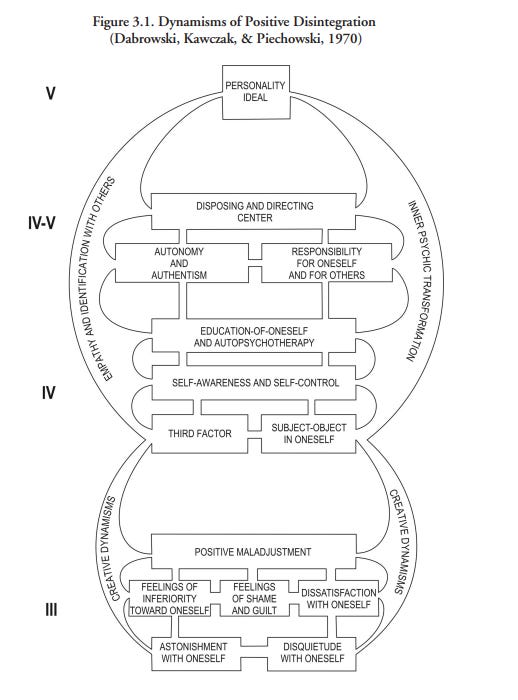
This, in essence, is Dabrowski’s Theory of Positive Disintegration (TPD): the idea that true growth often requires breaking apart the structures—internal and external—that no longer serve us. It’s a theory that resonates deeply with neurocomplex individuals, especially those who are twice-exceptional (2e) or possess what Dabrowski called “overexcitabilities” in their intellectual, emotional, and sensory lives. It’s not just a model for personal development; it’s a way of understanding why some of us thrive in the chaos of disintegration while others can’t imagine surviving it.
Level 1: The Comfort of Conformity

Dabrowski’s theory begins with primary integration, a state where individuals are driven by basic needs, societal norms, and external validation. At this level, life is simple—but only if you fit the mold. Success means doing what’s expected: getting good grades, following rules, climbing the ladder. For people who are comfortable here, disintegration looks like failure. Why question the system if it works for you?
But for people like me, Level 1 never felt like enough. Sure, I excelled in school—I got straight As without trying, aced the SAT after a night of drinking, and could balance partying with academic dominance. But I wasn’t striving for perfection. I didn’t even see it as an achievement; it was just the natural output of a brain wired to thrive in certain systems. My peers envied me, but I envied something else: the ability to feel like any of it mattered.
Level 1 is where many people stay for life, and that’s okay. But for those of us who feel the tug of deeper questions—about meaning, authenticity, and selfhood—it’s not long before cracks start to form.
Level 2: The Collision of Inner and Outer Worlds
The first step into disintegration is often subtle. You start to feel a tension between who you are and who you think you’re supposed to be. You question the rules, the expectations, the values you’ve inherited from society. For me, this was third grade: the year I was moved into the “Gifted” program. Instead of feeling proud, I felt alienated. The separation from my peers felt like a punishment for being different. By fourth grade, I chose to go back to the “regular” classes—not because I couldn’t handle the challenge, but because I couldn’t handle the loneliness.
Level 2 is a state of inner conflict. You start to realize that the life you’re living isn’t aligned with your deeper self, but you don’t yet have the tools—or the courage—to make a change. It’s disorienting and often painful, but it’s also the beginning of growth. For me, it was the start of a lifelong paradox: a desire to fit in, coupled with an inability to ignore the parts of myself that didn’t.
Levels 3 and 4: Breaking Apart to Build Anew
At Level 3, the real work begins. This is the stage of spontaneous multilevel disintegration, where the tension between your higher and lower values becomes unbearable. You start to dismantle the structures that no longer serve you—relationships, careers, identities—and it feels like chaos. But it’s not just destruction; it’s a reorganization. You’re sifting through the pieces of your life to find what’s worth keeping and what needs to go.
For me, this process played out in cycles. In college, I spent 5.5 years pursuing a degree—not because I couldn’t finish faster, but because I was too busy learning about life outside the classroom. I worked, started a business, got married at 20, and bought my first home at 21. It wasn’t a path of rebellion; it was a path of curiosity. I wanted to know what else was out there—what else I could be.
Later, in my career, I climbed the corporate ladder to high-paying leadership roles, only to burn out, clash with rigid systems, or walk away from jobs that didn’t align with my values. Each disintegration felt like failure at the time, but looking back, I see it as a necessary step toward something better.
Level 4 is where disintegration becomes intentional. You start to actively seek out the higher values that resonate with your true self. For me, this has meant stepping back from traditional success to focus on projects like AIs and Shine, a self-reflection tool that embodies the complexity of my own journey. It’s not about winning the game; it’s about rewriting the rules.
Level 5: The Integration of the Authentic Self
At Level 5, the journey comes full circle. This is the stage of secondary integration, where the tension between your higher and lower selves is resolved—not because the world changes, but because you’ve changed your relationship to it. You’ve created a life that aligns with your values, your passions, and your unique wiring.
I won’t pretend I’m fully there yet. Level 5 isn’t a destination; it’s a state of being that requires constant effort. But I can feel its pull. It’s in the moments when I stop apologizing for my complexity and start celebrating it. It’s in the projects I create, the relationships I nurture, and the risks I take to live authentically. It’s in the decision to step off the ladder, not out of defeat but out of intention.
Why Positive Disintegration Matters
Dabrowski’s theory isn’t just a roadmap for personal growth; it’s a validation of the struggle. It says that the chaos you feel—the breakdowns, the conflicts, the moments of doubt—aren’t signs of failure. They’re signs of transformation. They’re the growing pains of becoming who you’re meant to be.
For those at Level 1, this might sound alien. Why choose a path of disintegration when you could just stay comfortable? But for those of us who feel the call to something more, Dabrowski’s theory offers a framework for understanding what it means to live a life of depth and meaning.
Positive disintegration isn’t easy, but it’s worth it. It’s the process of breaking apart the pieces that don’t fit so you can build something that does. It’s the paradox of growth through destruction, of finding yourself by losing what you thought you were. And for those of us who live at the intersection of brilliance and struggle, it’s not just a theory—it’s a way of life.